
Aigul Akhmetshina: “I’m Not a Hundred-Dollar Bill That Everyone Has to Like”

Aigul Akhmetshina as Carmen in Damiano Michieletto's production of Bizet's Carmen, The Royal Opera ©2025 Marc Brenner
Aigul Akhmetshina is accustomed to living life on the edge: between rehearsals and flights, major opera houses and tiny rented apartments, the fear of stepping on stage and the feeling of absolute freedom that comes with the first notes. Today, she is singing Dalila in London and Berlin, reflecting on the cost of an international career, burnout, directing, criticism and the future of opera — and increasingly asking herself what lies beyond the familiar image of the "femme fatale."
We met Aigul in Berlin last summer, shortly before her debut as Dalila at the Staatsoper Berlin.
Let’s start with Dalila and the production of Samson and Dalila. You recently made your London debut in the role. How did it go?
When rehearsals began in London, I wasn’t quite a hundred per cent ready. I’d been through a period of burnout and exhaustion, and I was getting sick a lot, so I had to take a break and disconnect from the theatre for a while. But in the last ten years, I’ve had a proper holiday only a couple of times, and even this short break didn’t turn out the way I’d planned. In the end, I had to cancel L’italiana in Algeri in Berlin for health reasons.
I only knew about half of Dalila’s role, and memorising text has always been difficult for me, so I was under a lot of stress. Then, when I arrived in London, my spring allergies kicked in. They cause the vocal folds to swell, which means you have to sing under constant strain. I rehearsed and then performed the shows while taking steroids.
I was incredibly lucky with the team and my colleagues, many of whom I’d worked with before. My home theatre became a safe space for me. They supported me, gave me time to learn the role, and I always had pianists and my French coach close at hand. Thanks to that support, I was able to bring the production to life.
What was the production like?
The production itself was quite minimalist. It received its share of criticism, but there were moments when the scenes really worked and looked striking. Especially at the end, when I wore this glittering, beautiful costume and a huge crown.
The idea was that the characters worshipped the god of money, slot machines and everything that reflected the Philistines’ baser instincts. The Philistines worshipped these things, while the Israelites, naturally, were deeply religious and followed God. The production was somewhat abstract, without placing too much emphasis on any particular nation or country.
Every role needs time to grow. In the early stages, not everything you want to bring to a character has had time to settle into your body. That’s especially true when you’re working on a new production and a new role. It’s always an exciting, nerve-racking process.
Dalila feels completely different in my voice now. The role has become more organic, as though it has settled inside me. I find her much easier to sing now than I did at the beginning. She has developed with every performance, and that’s incredibly important to me. Those who came to every performance could probably see how I changed a little each time.
You had to do a great deal of psychological work to develop the character in London. How did you approach Dalila’s story?
In this production, Samson is somehow implicated in the death of Abimelech, Dalila’s brother. She wants revenge, but she’s also in love with Samson. It’s a double loss for her: she loses her brother while also risking the loss of the man she loves.
In that sense, they’re still somewhat pagan in their outlook. They believe in the principle of "an eye for an eye": there must be retribution for what has been done. Dalila avenges her brother, and despite her feelings for Samson, she doesn’t regret what she has done.

Aigul Akhmetshina as Dalila in Samson et Dalila ©2026 Mihaela Bodlovic
I don’t think people are born bad. They become bad because of their circumstances. Things happen in their lives, and certain factors shape their personalities and turn them into the people they become. And not everyone can simply forgive. Forgiveness requires a deep level of understanding and a constant effort to see things from different perspectives.
The world isn’t divided into black and white. There are so many shades in between.
One of the most challenging moments for me was just before the aria "Mon cœur s’ouvre à ta voix" — "Love, help me discover his secret and make him my slave" — when I had to let out a wild scream. Just moments earlier, Dalila is brought her brother’s body. She has just said goodbye to him and is waiting for Samson. When he arrives, she’s overwhelmed by a whole range of conflicting emotions.
Then the High Priest appears, wanting to extract information from her, and starts pressuring her: "He chose his religion. He didn’t choose you." All of this intensifies her own feeling of rejection. At that moment, Dalila is torn between grief, love, the desire for revenge and the pain of not being chosen.
She has a very important line: "My god of love," because she believes in a God of Love. It’s almost as though she’s saying that love is stronger than all your gods.
I find it difficult to play a villain like this. You have to be incredibly cold and calculating to say such things so skilfully without feeling any of them sincerely. It’s hard for me to find an ordinary human being in that character. The only explanation I can come up with is that she’s something like a narcissistic sociopath.
But she says these things when she’s alone, doesn’t she?
Yes. In Dalila’s first aria, she’s alone with her thoughts. Usually, when a character speaks to themselves, we assume that’s when they reveal their true feelings. But in her case, it’s very difficult to find them.
For example, in "Mon cœur," the manipulation begins to emerge in the second verse. You can always feel it because the harmony, tempo and movement shift slightly. Until that point, the entire long duet with Samson — at least in the London production — is an attempt to win him over. If he had said, "Yes, I’ll trust you with my secret. I’ll be with you," perhaps she wouldn’t have allowed him to be killed. She wouldn’t have handed him over to be torn apart.
In that production, Dalila was deeply connected to spirituality and energy. She was a little bit of a witch, a priestess of love. People came to her to feel something. She knew everything and possessed a certain power, almost a magical one.

Aigul Akhmetshina as Dalila in Samson et Dalila ©2026 Mihaela Bodlovic
At the same time, she didn’t approve of violence. She was fascinated by observing people. At the beginning, she keeps trying to understand: why are they fighting? Why are they constantly at odds with one another? She’s interested in the very nature of men. They have strength, but they use it in a way that makes no sense to her: they turn it against one another.
There are so many layers to this role. Unfortunately, the problem with the opera is that Dalila isn’t particularly well developed as a character. There are a lot of gaps in her story. We know that she and Samson have met before and that they had a romantic relationship. In her very first entrance, she says, "I have come to bow before you, my king" — the king of her heart. And she means it sincerely.
Then she sings him a romance about flowers blooming. She tells him that she has woven flowers into her hair especially for him and invites him to come to her. There’s no mention of a secret at that point. Then there’s this huge dramatic gap, and suddenly she’s singing, "Love, give me the strength to pour poison into his heart." And I find myself sitting there thinking: how did we get here?
How are you developing this story in Berlin? How does this production differ from the London one, not just visually but in the way you approach the role?
We have a very short rehearsal period here — just one full week, or perhaps a week and a half to two weeks in total, and even that isn’t entirely full-time. The original director, who staged this production in 2019, isn’t here, so we’re working with a revival director.
We’re essentially racing through everything. We have to learn the staging and run through the scenes, which inevitably leaves gaps. There’s no real opportunity to explore the psychology of the characters in depth, if there is a psychological concept behind the production at all.
Everything is different from London. The London production was very colourful, whereas this one is dark. We’re in a sort of stone space, almost a cave. But it’s wonderful for the voice because the walls give you something to resonate against. There were no walls in London, just a bare stage. So I’m grateful for that.
This isn’t a contemporary production in the sense of being set in the present day. It’s more like the Stone Age, with shamanism, desert imagery and certain archetypal figures. Samson and his mentor look almost alike: long hair, white shrouds. Dalila isn’t all that different from them, either.

SeokJong Baek as Samson and Aigul Akhmetshina as Dalila in Samson et Dalila, The Royal Opera ©2026 Mihaela Bodlovic
I like the fact that it isn’t set in the present day and doesn’t try to turn the story into a modern war. I hope we’ll manage to tell a compelling story from the very first performance, because our full run-through will effectively take place on the day of the performance itself. Unfortunately, that happens during the summer season. When a production is revived, the rehearsal period is always short, even when it’s a substantial opera like this one.
I’m incredibly excited to see how this role will grow. There’s so much you can experiment with, so much you can discover. It’s very easy to see Dalila as a seductress, a prostitute who’s been hired to find out a secret and then uses it against Samson. That’s the most superficial interpretation.
I always ask myself: why? Why did she say that? Why am I going there? What is my relationship to this moment? I ask five hundred questions, which is probably why I sometimes irritate directors.
And what if the director has answers to those questions?
Then that’s wonderful. Sometimes we come up with things together; sometimes I ask myself questions and answer them myself. And then I’m told, "Wonderful. But how exactly?" So I end up being my own director and choreographer.
Sometimes people tell me, "An artist has to find their own reasons for saying something." Yes, of course. But if the director doesn’t have an answer themselves, that’s a problem.
I really hope that Berlin will give me the opportunity to keep developing my Dalila gradually. She’s already completely different from the character I played in London. With every performance, the role settles more deeply into my body and becomes clearer in terms of voice, character and movement. I’m genuinely curious to see where this journey will take me.

Aigul Akhmetshina and Roberto Alagna in "Samson and Dalilah", Staatsoper Berlin
What have you found most challenging about singing Dalila, technically or emotionally? Is there a particular moment that requires especially intensive work?
At the moment, the biggest challenge is that I have a very specific idea of how I want to phrase certain passages, following Saint-Saëns’s intentions, but I don’t always have enough breath to execute them exactly as I’d like. For example, there’s a famous passage in "Mon cœur" that Olga Borodina could sing in a single breath, which is genuinely difficult.
But I always take into account the circumstances in which we hear a singer. Recording a single aria in a studio is one thing. Singing an entire opera after several hours of work and then having to deliver that same phrase on stage is something completely different.
I’ve recorded an album myself, so I know perfectly well how much you can polish a recording. You can record one phrase, then another, piece everything together, make adjustments and record sections again. It’s a completely different technique, and the result sounds different, too.
Singing into a microphone is also a very different experience. Microphones pick up all sorts of details that the human ear simply doesn’t register in the auditorium. Sometimes they capture the less attractive qualities of a voice particularly well. You can hear someone live and think, "My God, what a beautiful voice," then listen to the recording and wonder what happened. And the opposite can happen, too: you barely hear someone in the theatre, but on the recording their voice sounds divine.
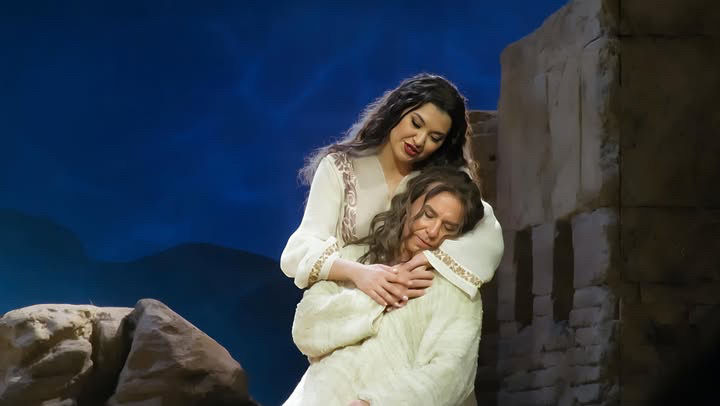
Aigul Akhmetshina and Roberto Alagna in "Samson and Dalilah", Staatsoper Berlin
I still don’t think we have microphones capable of fully reproducing the human voice, with all its overtones and frequencies, in the way the human ear perceives it.
I have a particular idea of how I want to phrase Dalila’s music, and I’ve drawn some inspiration from Jessye Norman. She sang "Mon cœur" live in a single breath, which is absolutely extraordinary. But again, it depends on the individual singer — their breathing, their body and the condition of their voice.
Body mass matters, too, because breathing capacity is influenced by physiology. When I first sang Dalila, I had lost quite a lot of weight.
Were you trying to lose weight at the time?
No, it wasn’t Ozempic, in case anyone is wondering, because that’s immediately what people tend to assume. I started losing weight because of stress. I have trouble sleeping and barely sleep at all. I can forget to eat, and sometimes I eat only once a day. So when I first sang Dalila, I was in a very different physical condition. I was also dealing with burnout, which I’m still gradually recovering from.
I don’t hide this or feel ashamed of it, and I think it’s important for other artists to know about these experiences, too. Of course, we often learn only from our own mistakes. No matter how many times someone tells us, "Don’t do that," we still think, "I can handle it. I’m a machine. I know my own limits."
That’s the mentality we often have: constantly putting ourselves last. But our bodies aren’t inexhaustible. It’s as though you’re borrowing from your body, and eventually it comes to collect everything you owe.

Aigul Akhmetshina and Roberto Alagna in "Samson and Dalilah", Staatsoper Berlin
Director, Singer and Opera: “We Need a Foundation on Which to Build the Character”
You often talk about how important it is for you not just to sing a role, but to understand its psychology. How much depends on the director?
There’s a real problem with directing in the opera industry today. Productions are often entrusted to well-known or fashionable directors, and opera houses invite them partly because they think audiences will come for the name. These may be directors from theatre or film, but they don’t always understand the specifics of opera or, more importantly, what it means to work with opera singers.
Opera is very much a team effort. Depending on the production, there can be as many as three hundred people involved: a large chorus, an orchestra, actors, dancers, extras, singers, stage crew, costume designers, makeup artists and so on. If you don’t respect everyone’s contribution, the whole system falls apart. You simply can’t build a production if everyone is constantly trying to make it all about themselves.
We live in the twenty-first century, when collaboration is increasingly important. If someone is always trying to dominate, I see it as a sign that they may lack professionalism or confidence in their own abilities. A good director comes prepared, with a clear idea. They know the opera, understand the music, can read a score, understand the dramaturgy and speak our language. They don’t necessarily have to know every technical aspect of a singer’s work, but if they do, that’s a huge advantage.
Have you worked with directors who fit that description?
David McVicar, for example. Maria Stuarda at the Teatro Real was probably the safest working environment I’ve ever experienced because everything had been thought through so carefully. He knew exactly when each instrument came in and seemed to know the music almost better than I did. I honestly felt like a complete fool. I kept thinking, "Wow!"
At the same time, he gave me room to work. His productions are classical, fairly traditional, but he respects the libretto. And I think that’s very important. If you want to create something entirely contemporary, use contemporary dramaturgy or write new operas. I have nothing against modern productions. But some works have an internal logic rooted in a particular historical reality. Madama Butterfly, for example.

ROH Samson et Dalila ©2026 Mihaela Bodlovic
But surely modern opera demands much more from a singer than vocal technique alone?
Of course. These days, being a singer isn’t enough. You have to be an actor, a dancer and sometimes practically a juggler. You have to keep learning and developing new skills. I understand why this is happening: we live in a high-tech age in which our attention is constantly being pulled in different directions. To hold an audience’s attention, performers have to keep them engaged.
We’re all multitasking now. We text, watch television, type something on a computer, iron clothes and talk to someone, all at the same time. We’ve become accustomed to doing several things at once, and the same thing has happened in theatre. Simply standing there and singing no longer works. You have to tell a story, act and truly live through it.
I rarely feel proud of my performances, but there have been a handful that I can count on my fingers when I knew I’d given absolutely everything I could at that particular moment. Those performances marked my growth as an artist.
There are many directors who come from theatre or film without fully understanding the specifics of opera. But we need a clear structure. You can’t come to a group of singers three weeks before opening night and say, "Let’s just explore the material." We have to learn the text and music, pronunciation, choreography, movements and interactions with our partners. We also have to remember all the technical details: where to pull something out of a costume, where a costume might tear. And through all of that, we still have to stay in character.
That’s why we first need a solid foundation on which to build the character and add the details — all the seasoning, if you like.
When a director has no clear idea, the process becomes exhausting and extremely difficult. At a certain point, you end up directing yourself. But if you’re singing the leading role, you’ll still be blamed for everything: the costume, the set design, your singing, your pronunciation — absolutely everything.
I always tell myself, "I’m not a hundred-dollar bill that everyone has to like." It’s a useful phrase, although it doesn’t always protect you from criticism or stop you from worrying.
I’ve worked with people who didn’t even know what the opera was about. If you can’t read music, that’s fine — you can learn the musical cues. But every score has numbers, bars and page references. You can say, "Let’s start at number eight, bar twenty-eight," and everyone knows exactly where we are. You can’t just say, "Let’s start here and imagine whatever you feel like." That’s not how you work.
And how are directors who come from film different?
They’re used to working with close-ups, as you do in cinema, but there are no close-ups in theatre. Sometimes directors become so focused on naturalistic details that nobody in the auditorium will ever see them.
In opera, we’re already improvising all the time. You can never repeat a performance in exactly the same way. But we still need clear choreography that we can return to. When you’ve been working for hours, when you’re exhausted or simply not feeling well, you can sometimes experience a blackout. At those moments, it’s essential to have a clear point of reference — an anchor you can return to and use to find your way back into the performance.
An opera lasts three hours, and you have to keep an enormous amount of information in your head, especially when you’re singing in French. I perform a lot of French repertoire, so I constantly have to work on the language. And yet I adore both the music and the language itself. We have a complicated relationship: I love it and hate it at the same time.

Emyr Lloyd Jones as Philistine Messenger, Siphe Kwani as Second Philistine and Aigul Akhmetshina as Dalila in Samson et Dalila ©2026 Mihaela Bodlovic
What exactly do you find most difficult about French?
The music itself isn’t difficult for me; it’s the language. There are so many vowels, and sometimes even the slightest change in a vowel sound can throw everything off. You can find yourself standing on stage, singing an aria, without a solid foundation.
The director comes over and says, "I want you to have this philosophical expression. Do something." Then the French coach arrives and says, "I want a different sound here."
Next, the choreographer asks you to move your foot five millimetres and turn your head slightly to the left. Then the conductor comes along: "I want us to go faster here, move straight into piano here, and suddenly switch to forte here."
After that, the stage manager warns you, "Be careful here, because this table is dangerous and you could hurt yourself. There’s a knife here; you need to pick it up. There will be blood here, so keep that in mind."
Meanwhile, a colleague might tell you, "I’m not feeling well today, so please be ready to cover for me if I struggle."
And you’re thinking about all of that at once, while also trying to focus on the character, the music, the language and the movement. Everything is happening simultaneously.
On top of it all, there’s self-doubt. Paradoxically, the more you sing, the more anxious you can become, because there’s more criticism. That’s normal, but there’s a difference between constructive criticism and criticism that has nothing to do with your work.
Once you become a public figure, people criticise everything: your appearance, your voice, your pronunciation. But art is subjective. Some people will like you; others won’t. If you don’t like me, don’t come to my performances.
If you want to compare me with singers from a hundred years ago, go ahead. But times have changed. I’m not sure those same artists would be able to work in the same way under today’s schedules and living conditions.
When people compare us with artists of the past, they often forget that they had different working conditions, different salaries, different schedules and an entirely different professional environment.
Today, a singer has to be a performer, their own manager, a traveller and an administrator, dealing with paperwork, logistics and a dozen other responsibilities. And all of this happens alongside the one thing that matters most: stepping onto the stage and telling a story.

Aigul Akhmetshina as Carmen in Damiano Michieletto's production of Bizet's Carmen, The Royal Opera ©2025 Marc Brenner
The Price of the Profession: Health, Burnout, Stage Fright and Life on the Edge
You’ve spoken about the constant pressure and the enormous number of responsibilities that come with being an artist. How difficult is it, physically and psychologically, to sustain this kind of career?
It’s incredibly difficult, and I don’t think people talk about it enough. Everyone sees the artist on stage, the beautiful costumes, the lighting, the orchestra and the applause, and it all looks like a wonderful life. But behind that image lies an enormous amount of work, constant pressure and a tremendous sense of responsibility.
At the same time, performers’ fees have barely changed in years. People say, "Oh, you’re artists — you earn so much money!" But as far as I know, the upper limit for a fee per performance at an opera house is around €13,000–14,000, and even superstars might earn about €15,000. Around 45 per cent goes in tax, and then there are agency fees, usually around 20 per cent of the fee, depending on the agency. After that come all the other expenses: accommodation, flights, insurance, visas, medical costs, medication and food for the entire time you’re away.
And once you reach a certain level in your career, you have a team of people you work with. You need photoshoots, concert dresses, and possibly an assistant, which means paying a monthly salary. Then there are lessons, scores, coaching sessions, language classes and pianists. You’re investing money in practically every aspect of your profession before you’ve even earned it.
When I paid my taxes in January, I practically had a breakdown that lasted almost two weeks. I couldn’t understand what I was working for, because I was earning money only to spend it all again.
Of course, you can rent a tiny, uncomfortable apartment somewhere far away, in an inconvenient location, and take flights at terrible times. But after ten years of living like this, it stops being sustainable. You become someone who has no real home, constantly flying from one place to another, a nomad. The whole world becomes your home, and the theatre you’re working in at any given moment becomes your home, too.
Eventually, you want to create at least some comfort for yourself, because you have no permanent home and nowhere to feel grounded. So you try to find more comfortable accommodation, or treat yourself to something delicious. Sometimes, you just need to eat your way through a little stress.
Being a singer is stressful. It’s a kind of masochism. Perhaps no entirely sensible, well-adjusted person would choose this life, but artists are a little eccentric. We’re creative people. We love the adrenaline, even though it eats away at our nerves and our health. And eventually, we can’t seem to live without it.
I suppose my only real addiction is adrenaline — the rush of going on stage and the fear that comes with it. Every time I walk on stage, I’m absolutely terrified. These days, it can even lead to panic attacks. But then you step out there, and afterwards you feel that you’ve done it, that you’ve overcome yourself. Every performance is another challenge: can I do it, or can’t I?

Aigul Akhmetshina as Carmen, Piotr Beczała as Don Jose in Carmen ©2024 Camilla Greenwell
But you’re talking about more than just psychological pressure. You work incredibly hard physically, and your voice is constantly under strain, too. How are you coping with all of this now?
I honestly can’t remember the last time I sang when I was completely healthy, when I had full control of my voice and it felt truly free.
People say, "You can simply choose not to go on stage." But audiences buy tickets, and sometimes people fly in specifically to hear you. Cancelling a performance is incredibly painful because you don’t want to let anyone down. But you also have to understand that if you lose your voice, not many people will necessarily be there to help you. So you have to find a balance and remember that if you don’t look after yourself, no one else will. It’s like the safety instructions on a plane: put your own oxygen mask on before helping someone else.
I’m very concerned about what’s happening in the opera world. I see the industry gradually deteriorating, audiences disappearing and financial support declining. Even internationally renowned singers are struggling with fees.
We’re paid for appearing on stage and for the time we spend performing. If you don’t go on stage, you don’t get paid, even if you’ve spent a month and a half preparing for the production and have already paid for accommodation, flights and everything else.
For example, this September I’ll have a period when I’ll be at home in London for only a month and a half or two months. After that, I’ll spend ten months flying around without returning home. I travel with overweight suitcases, and I also pack several smaller suitcases in advance and leave them at home.
When my friends come to see my performances, they collect a suitcase from my home and bring it to wherever I am. I swap suitcases, send the things I no longer need back home with them, and pay my friends for each suitcase they transport. There’s always some kind of logistical puzzle to solve.

Aigul Akhmetshina as Carmen in Damiano Michieletto's production of Bizet's Carmen, The Royal Opera ©2025 Marc Brenner
And you don’t even receive the money you’ve earned straight away?
No. You often receive your fee a month after completing a contract, if you’re lucky. Sometimes you can wait six months, depending on the project.
I remember the early years of my career, when I was effectively lending money to my own agency because my earnings arrived so late. Meanwhile, I needed to apply for visas and rent accommodation somewhere else. I’m incredibly grateful to the friends I have all over the world who let me stay with them.
But when you spend so much time constantly surrounded by people, something else happens, too. I’m both an extrovert and an introvert. I’m very sociable, I have friends all over the world, I love people and want to spend time with everyone. But when you’re constantly around others, continually giving away your energy without having the opportunity to replenish it, you eventually want to hide away.
If I have one or two days off, I turn into a little wolf cub. I put on my black hoodie, close the doors, draw the curtains and don’t want to see anyone. I don’t want to talk to anybody because I simply have no energy left. I might spend the whole day lying down, staring at the ceiling. I need to recharge. It’s both a blessing and a curse, because I love people very much, but sometimes I simply have nothing left to give them.

I also have a principle I try to live by: life is very short. It’s important to live today, here and now. I repeat that to myself all the time. You have to appreciate the little things, even though everyone has their own problems.
We’re already living a completely abnormal life. Building a personal life is almost impossible, especially if you’re a woman. You’re constantly immersed in your profession, and then questions arise about who earns more, who earns what, and how everything works. You have to be an incredibly strong person to sustain this lifestyle. From the outside, it looks exciting and glamorous, and of course, it really can be. But our lives are full of contrasts.
Sometimes I can’t even make sense of what’s happening. One day, I’m having dinner with a king at some event; the next, I’m flying in a helicopter, being picked up by friends and taken somewhere else. A few days later, I’m sitting in McDonald’s eating a burger because I haven’t had time to eat properly. Or I’m rushing around all day without knowing where I am. Or I’m dragging 84 kilograms of luggage up four flights of stairs because there’s no lift.
With this kind of lifestyle, even ordinary everyday life must become a job in itself.
Absolutely. You constantly have to keep track of the rules in different countries. You arrive somewhere, and suddenly the entry requirements or work regulations have changed, which means you have to redo your paperwork. You’re under constant stress, and eventually you have no time or energy left for creativity and the actual artistic work.
People say, "You can simply take on less work." But the industry is moving so fast that once you’ve boarded this high-speed train, slamming on the brakes can cause the whole thing to fall apart. The same happens to us. The industry keeps moving forward, offering invitations, demanding more and proposing the next projects. You have to develop a sensible relationship with your work, find the right balance and build good relationships with everyone around you.
I always try to remember the opera houses that helped me at the beginning of my career, the ones that supported me, gave me opportunities to prove myself and allowed me to step onto the stage. Thanks to them, I can now sing on the great stages that every artist dreams of performing on.
But all of this comes at a price. As the saying goes, be careful what you wish for.
Do you feel that the pressure only increases as your career grows?
I often miss the time when nobody knew who I was. Before I had a title attached to my name. I don’t particularly like being called "the Carmen of our time" or something similar, because with that kind of title come expectations.
Every time you enter a theatre, it’s like starting school all over again. You have to prove that you deserve to be there. You have to prove yourself to the chorus, the other performers, the musicians, your colleagues and everyone who is there to support you.
The more time you spend on stage, the more insecure you can become, because the fall hurts more when you’re higher up. There’s more press, more people scrutinising you. They no longer simply expect a good performance; they’re looking for flaws, something to criticise or compare. They say, "You used to sing better," or, "We knew it — she’s young, she’ll burn out quickly." Or, "That’s not the right repertoire for her anymore," "She’s an unfinished soprano," or, "She’s a grassante." I’ve often been criticised for my speech impediment.

Aigul Akhmetshina as Carmen, Piotr Beczała as Don Jose in Carmen ©2024 Camilla Greenwell
But speaking and singing are two completely different things, aren’t they?
Yes, but people still notice if the diction isn’t clear enough. They might say they can’t understand the words, that your acting is too restrained or too exaggerated, or that your costume doesn’t fit properly.
They might comment on your figure: your double chin, your triple chin, something digging into your skin, or the way your clothes look on you. You can be criticised for absolutely anything.
What particularly astonishes me is how often these attacks seem to come from women towards other women. I’ve always loved the expression, "A woman should be a home for another woman," but unfortunately, that isn’t always how things work.
I don’t know where all this negativity comes from — insecurity, jealousy or something else. But there are plenty of opera houses. If you think you can do better, then please, go out there and do it. I haven’t taken your livelihood away from you. The criticism can come from fellow singers, colleagues or other people in the industry. They find something to criticise about everything.
I understand that it’s impossible to please everyone. But no matter how strong your armour is, it will eventually develop holes, and some of the criticism will get through. Especially when you’re feeling vulnerable.
What has helped you recover from burnout and learn to take better care of yourself?
Gradually, I’ve started taking breaks and leaving more time between performances, trying to find a balance. These days, I can allow myself little pleasures. For example, I love going to the sauna, so wherever I travel, I try to find one. These are small gifts I give myself — ways of making my inner child happy. I think it’s very important not to forget about these things.
I’ve also been working with a psychologist for several years, and I’m incredibly grateful to her. I consider it the most important investment I’ve ever made in myself. I’m constantly working on myself, trying to find a balance between what I have to do, what I want to do, what I’m capable of, my profession, my life and my friendships.
Because ultimately, when you’re gone, nobody will thank you for going on stage when you were ill. If you perform while sick, you may be criticised. If you cancel, there will still be people who are disappointed.
My psychologist often reminds me of something I’ve also read in various books: other people are responsible for their own emotions. You can’t take responsibility for how everyone else feels. You do the best you can. You’re not deliberately trying to hurt anyone. But you’re human, too.
Sometimes, when people direct negativity at me, I wish they would stop and think about what they’re writing and who they’re writing it to — whether it’s an anonymous comment on social media or something they say to someone’s face. You never know what another person is going through or what problems they’re dealing with. And if you wouldn’t say something to someone’s face, perhaps it’s better not to say it at all.
I don’t believe any public figure is obliged to accept criticism without reacting. We’re human beings, and we have feelings. Artists are often particularly sensitive and empathetic people. Of course, some people seem completely insensitive, while others are extremely vulnerable. Some become so thick-skinned that they appear to switch off their emotions altogether. But even then, I think something remains somewhere in the subconscious.
I feel that what the world needs most right now is humanity and compassion. And I believe art can help bring those qualities back.
People go to the theatre, visit galleries, listen to music and attend rock and pop concerts because they want to feel something. That’s why I believe people who are drawn to art cannot be entirely cruel or devoid of feeling. I want to believe that our audiences are empathetic, kind people. If someone is drawn to beauty, knowledge and things that make them feel something, then there’s already a desire for something more within them. I wouldn’t necessarily call it something "elevated" — that sounds too grand. Just something that makes you feel.
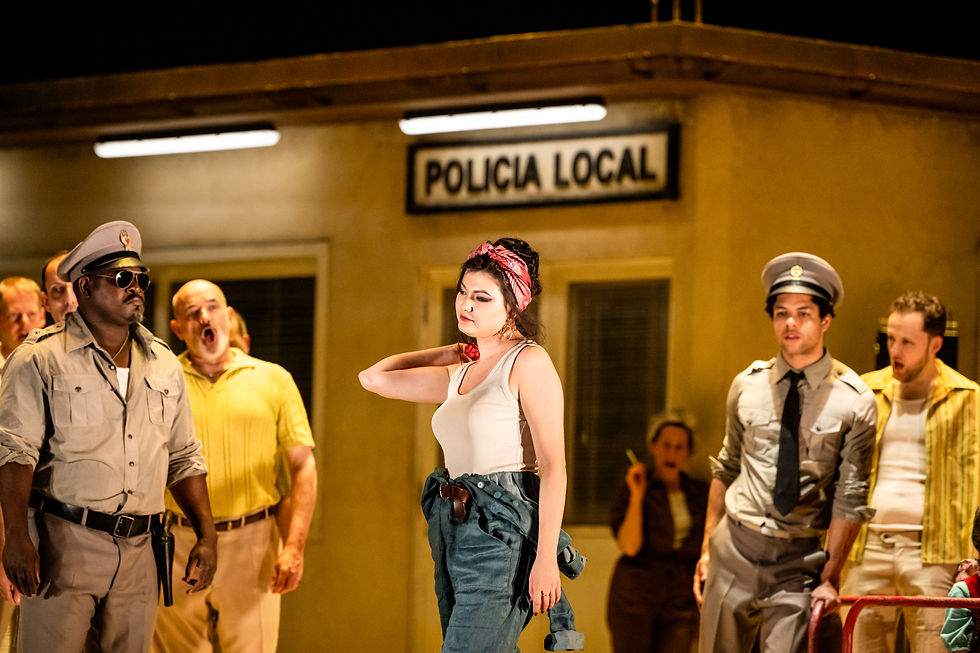
Blaise Malaba as Zuniga, Aigul Akhmetshina as Carmen in Carmen ©2024 Camilla Greenwell
“My Mission Is to Bring People Together”: Art, Dreams and the Future of Opera
You speak about art as a space that makes people feel something. Perhaps that’s why so many stories we see in opera, despite being set in entirely different eras, still feel relevant today?
Yes, because if you look closely, all operas are relevant to our time in one way or another. Humanity keeps going around in circles, and we see that people haven’t really changed. Nations are still fighting one another, religions are still in conflict, and the world continues to divide. We see countries closing their borders, making entry more difficult and becoming increasingly embroiled in conflict.
I don’t know whether this is deliberate or not, but people are constantly being pitted against one another. I always say that my mission is to bring people together. I’ve always believed in that, and I always will.
Ever since I was a child, I’ve been fascinated by discovering the world and understanding why things are the way they are. It’s wonderful that we’re all different. It would be terribly boring if everyone were the same. We look different, have different interests and life stories, and speak different languages. I’ve always loved different cultures.
I’ll never stop saying that the theatre should be a safe space for everyone. It isn’t always, but I hope that one day I’ll be able to establish my own organisation and create a space where people genuinely feel safe.

Aigul in a wedding dress by Lawenda Atelier, photo by Shristi Dutta, for Voci dell'Opera
Do you already have an idea of what that organisation might look like?
I’m very ambitious, and I dream a lot. I write my dreams down in a wish journal — my bucket list. I put everything in there, from huge ambitions to completely absurd little things. Sometimes I’ll write down something as simple as wanting to try a particular chocolate bar or ice cream. I still haven’t tried Dubai chocolate, actually, despite everyone talking about it.
But there are bigger ambitions on the list, too: doing as much charity work as possible, making it onto one of those lists of the world’s most influential women, buying a little house by the sea and owning an apartment in London. There are so many things I want to do.
I want to establish an organisation to train agents and artists, and I want to create collaborations with different performers. I’m constantly coming up with new ideas. I love bringing people together and creating projects that haven’t existed before.
What else would you like to sing? Are there any roles that remain a dream for you?
I would really love to sing Baroque opera. So far, I haven’t been offered Baroque roles because people say my voice isn’t quite suited to them. I’m also beginning to lose some of my flexibility, so I’d really like to try something in that repertoire while I can.
I’d love to sing a trouser role, perhaps in Giulio Cesare. I’ve already imagined the perfect cast: Kristina Mkhitaryan, Nina Minasyan and me, all coming together to sing Alcina.
These days, when I accept a project, I often ask who the director is, who’s conducting and who my colleagues will be. Fortunately, I’m now in a position to choose. Sometimes a production can be wonderful, but the colleagues or conductors can be very difficult to work with. That happens, too.

Italiana in Algeri, Andrey Uspensky
You often talk about how important it is for an artist to choose the right team. What advice would you give to young singers who are just starting out and don’t yet have that freedom of choice?
I always tell young artists to have faith, big plans and great hopes. You need to have a higher goal to work towards. This profession doesn’t necessarily bring you a lot of money, and fame alone won’t satisfy you in the long run.
You need to understand what makes you willing to endure this profession, because, like any other, it has its advantages and disadvantages. People don’t always realise how much the job demands of them when they first enter the industry, or what they’ll have to sacrifice along the way. You need to understand that from the beginning, so you can return to that thought whenever things get difficult and remind yourself why you started. Ultimately, you’ll have to find ways to motivate yourself.
I often find inspiration in other artists, colleagues and collaborations. Working with people who are masters of their craft, people you can learn from, is an incredible experience. When you improvise together and everyone does their part, something extraordinary happens — a sense of unity. It’s like a dance: everyone has their role, and when each person fulfils it, the dance becomes harmonious. I think the same principle applies to all relationships.

Aigul in a wedding dress by Lawenda Atelier, photo by Shristi Dutta, for Voci dell'Opera
You’ve also said that you feel artists are receiving less respect within the industry. Why do you feel that way?
Nowadays, the conductor comes first, then the director, and so on. Everyone is placed ahead of the singer, who ends up somewhere near the bottom of the hierarchy. If you’re a top artist singing the leading role, you may receive the appropriate treatment. But even then, people can say whatever they like behind your back.
For young artists who are just starting out, there’s often a basic lack of respect for their time. And time is the most precious thing we have in life. You can never get it back. I get very frustrated when someone wastes my time, and I always try to respect other people’s time, too. That’s why I constantly ask myself: do I really want to spend my time on this? Once it’s gone, I’ll never get it back.
I also try to stand up for people whenever I can. I feel that I have at least some influence now, and I understand that one day it may disappear. So while I have it, I try to use it to make a difference.
I’m something of a fighter and an idealist. Of course, swimming against the current can be exhausting.
Sometimes you have to let go, go with the flow for a while and then gradually start changing things. You can’t break down every obstacle with a crowbar. Sometimes you need to be diplomatic and tactful. Building something substantial takes time.
You often use architecture as an example. Is that connected to your approach to art?
Yes. Sometimes I walk around looking at historic architecture and think about how beautifully everything was constructed. Those buildings were designed to last for centuries because the foundations were right. Today, many buildings are put up quickly using basic materials, and a few years later they’re already falling apart. Much of contemporary architecture strikes me as bland, minimalist and boring.
People used to aspire to beauty. I don’t understand why we should have to give that up. I still struggle to understand many directorial interpretations. I genuinely believe that if you create something truly beautiful, it doesn’t necessarily have to be modern. A classical production can be just as appealing to audiences.
Aigul in a wedding dress by Lawenda Atelier, photo by Shristi Dutta, for Voci dell'Opera
But directors often justify modern productions by saying that audiences need something new.
What’s interesting is that they often just want to do something different, something nobody else has done. They also frequently claim that younger audiences want modern productions. I’m not sure that’s true. I sometimes think the opposite is the case: young audiences want to experience classical productions because there’s so little traditional staging left.
I’ve probably performed in fifteen or sixteen productions of Carmen, and only two of them were classical.
But Carmen is one of those operas that seems to withstand almost any interpretation.
And I still haven’t sung my best Carmen. Perhaps when I finally do, I can stop performing it — because then I’ll know I have nothing more to bring to the role.
I can never quite let go of her. If I haven’t sung her for a long time, I miss her. We’ve become so closely intertwined. And we filmed my documentary all over the world, which was also connected to Carmen.
How do you envision the future of opera? Is it possible to find a balance between classical and contemporary productions?
I think opera houses could alternate between them. They could stage a couple of contemporary productions and a couple of classical ones, allowing audiences to choose.
Unfortunately, we often end up spending enormous amounts of money on additional permissions, licences, the use of certain materials and compliance with an ever-growing list of requirements. We constantly have to demonstrate that everything is environmentally friendly, that materials are recycled and that all kinds of regulations are being followed. As a result, a huge amount of money goes towards administration rather than directly to the artists.
Dancers, actors, chorus members and other employees work within a system that offers a certain level of stability. But singers, freelance actors, dancers and many other performers often don’t have that security. I understood this particularly clearly when I paid my taxes. I realised that if I can break even and avoid going into debt, I should consider that a success.
I was fortunate to save some money earlier in my career, when taxes were lower, I had fewer people working for me and I was saving on practically everything and keeping a close eye on my expenses.
Back then, I could stay in very different conditions. I remember my New York debut, when I rented a studio on the ground floor, almost in the basement. It was clean and had been renovated, but there were cockroaches and rats. There was a huge gap in the window, and in winter the cold air came straight through it. I bought a newspaper from the street, wet it the way my grandmother had taught me, and stuffed it into the gaps to stop the draught. The window was right next to my bed. On my first day in New York, I spent my time sealing up the windows.
Aigul in a wedding dress by Lawenda Atelier, photo by Shristi Dutta, for Voci dell'Opera
When you don’t even have enough money to eat properly, you really do begin to live differently. You’re constantly moving around, staying with other people, and I’m still grateful to everyone who took me in during those years.
But now, of course, I want a place of my own, somewhere I can have a sense of home and everyday routine. Every time you arrive at a new apartment, you have to start building a life there all over again. You buy a frying pan, then whatever else is missing, and try to make the place feel a little more like your own.
And that, too, is part of this profession that almost nobody talks about.
Living Out of a Suitcase: Accommodation, Travel and the Cost of Mobility
You’ve talked about constantly moving between cities and apartments. How safe and comfortable is it for an artist to live this way?
Several of my colleagues have arrived at apartments only to discover that someone else was living there too, or that someone was hiding in another room.
During my first year, when I went to Rome for my first travelling contracts, I was told I’d be staying in a studio apartment. I arrived in Rome and discovered that it wasn’t a studio at all, but some kind of three-bedroom apartment where they were simply renting out one room. There were five men there whom I didn’t know. I was alone, my bedroom door wouldn’t lock, and the bathroom was shared. Naturally, I was frightened. It was the middle of the night, and the men were behaving in a rather intimidating way. I felt completely unsafe.
The landlord was also a rather shady character. I was a young woman travelling alone in a foreign country. I barely spoke Italian, and they didn’t speak English.

Aigul in a wedding dress by Lawenda Atelier, photo by Shristi Dutta, for Voci dell'Opera
So accommodation really does become one of the biggest expenses?
Yes, and prices everywhere are absolutely insane. I paid $15,000 for that apartment in New York for just a month and a half.
That’s another thing people fail to take into account when they look at an artist’s life from the outside. They see the fee and think, "That’s it — they’ve made a fortune!" But they don’t see how much of that money you’ve already spent just getting to the city and making it onto the stage.
You also work with young artists all the time and explain how the industry works. What is the biggest challenge today for a young singer trying to break into the profession?
It’s genuinely harder to break into the profession now, because many agents no longer even listen to recordings the way they used to. There are major competitions — Operalia, Cardiff and other well-known contests — but winning or placing in them doesn’t guarantee you a career. If you don’t have an agent or someone willing to vouch for you, it becomes extremely difficult.
Another important point is that a competition and an opera performance are two completely different things. You can sing brilliantly in a competition and then struggle to inhabit a role. Conversely, a singer might do badly in a competition, or simply not perform at their best, but deliver a wonderful performance on stage.
You can only truly understand someone by seeing them at work. But many opera houses simply can’t give young singers the opportunity to try things out. They don’t want to take risks — or rather, it’s not that they don’t want to; they simply can’t afford to. It’s expensive. Opera houses are underfunded, and budgets are being cut everywhere.
I also think that money is sometimes allocated poorly. I won’t name specific theatres, but it happens. Sometimes they try to save money by hiring lots of people who don’t know what they’re doing, and in the end they have to spend even more. As the saying goes, if you buy cheap, you pay twice.

Andrzej Filończyk (Figaro) and Aigul Akhmetshina (Rosina) © ROH | Bill Cooper
Young artists often want to get into the most prestigious opera house straight away, sign with a major agent and land a leading role. What do you tell them?
All ambitious young artists want the same things: "I want the best agent, I want to go straight to the best opera house, and I want the leading role." But that’s not how it works.
Major agents are increasingly reluctant to take on singers who are just starting out. If an agent doesn’t have a team working with second-tier opera houses, they may not have connections with those theatres at all. That means they might not be able to find work for you. An agent has only so much time. If they represent A-list artists who are constantly in demand at major opera houses, almost all their time goes towards those singers. There are only twenty-four hours in a day.
When an agent speaks to a casting director, they usually discuss a whole package of artists. If you’re not an A-list artist yet, it can be difficult to get you included in that conversation, because top-tier opera houses want established performers. They need to sell tickets, and they need to know who they can rely on.
If you’re part of a young artists’ programme at the same opera house, you might be given a small role. You’ll go on stage and sing your equivalent of "Dinner is served!" But that’s important, too. In fact, a small role can sometimes be much harder to sing than a large one. With a major role, you have the opportunity to develop your character, settle into the performance and give yourself time to grow into the part. You also have room to correct things along the way. But if you have a ten-minute role, you have to do everything in those ten minutes.

Aigul in a wedding dress by Lawenda Atelier, photo by Shristi Dutta, for Voci dell'Opera
Have you had that experience yourself?
Yes. One of my greatest professional achievements was singing Sonetka in Lady Macbeth of Mtsensk. It was after that performance that The Times wrote about me: "Aigul Akhmetshina was a real bitch."
So they summed me up in a single sentence. Thank you very much! But the interesting thing is that the review immediately began circulating among opera houses, and my agent was able to use it to help me get further work.
You started working with your own agent from the very beginning, even though, as I understand it, major agencies also became interested in you at one point?
Yes. I started out with my agent, and at the time many people said to me, "Why are you signing with him?"
After one performance, several major agencies began showing an interest in me. But I still chose to stay with my agent because building a relationship together mattered to me. People told me, "He is nobody." And I replied, "Well, I’m nobody yet, either. Let’s build something together."
And that’s exactly what we did. We built everything together. Now we stand up for one another, discuss all kinds of things and work as a team. That’s very important to me. My team is gradually becoming my family. If I can’t trust the people around me, how am I supposed to work?
So how should a young singer go about finding an agent? Where should they start?
You need to take responsibility for building those relationships yourself. You can enter competitions and attend auditions. If you’re already part of a young artists’ programme, that’s an excellent opportunity.
If your programme lasts two years, ideally you should have an agent by the end of the first year. They need time to find work for you. If you only find an agent towards the end of your second year, the period that follows could turn out to be completely empty.
And it’s very important not to immediately contact every major agent who works exclusively with top performers. Start smaller.
For example, visit an agency’s website and look at its roster. If it already represents ten sopranos and ten coloratura sopranos, it may simply have no need for an eleventh coloratura soprano.
Look at the voice types the agency represents, where those singers work, which opera houses they perform in, and whether the agency actually has opportunities for someone with your voice type.

Gordon Bintner as Don Giovanni and Aigul Akhmetshina as Donna Elvira Credit: Alastair Muir
You can also try contacting singers who already work with that agent and ask them about their experience. One person might reply, another might not, and a third might get back to you a month later. But it’s still a way to find out whether that agent might be right for you.
Once you’ve done your research, you can send the agent your CV and a video.
What should that video and CV look like?
The video doesn’t have to be a professional production filmed with an enormous camera. Good sound is what matters most. You can introduce yourself, state the name of the aria you’re going to sing, and perform two or three arias that genuinely showcase your voice.
But you need to understand which roles you want to pursue and what your voice type is. Don’t send someone your entire possible repertoire simply because you can sing a bit of everything. The agent needs to develop a clear picture of your voice and understand what
kinds of roles they could market you for. You can experiment more once you have an agent, and together you can explore how your career might develop.
Your CV should be short. Not thirty pages — one page containing the information that really matters: competitions, masterclasses, roles already in your repertoire, where you’ve performed, whom you’ve worked with and your stage experience.
If you’ve attended important masterclasses with well-known professionals, you can include those, too, so that an agent has people they can contact for references. And don’t forget the practical documentation: visas, citizenship and your ability to travel or work in different countries. That matters to an agent as well.
And what if an agent doesn’t reply or turns you down?
It’s not the end of the world. You have to keep knocking on doors. Many excellent agents start with small rosters and gradually build their businesses. And you shouldn’t turn your nose up at smaller agencies or opera houses.
In Germany, for example, ensemble theatres can be an excellent place to start. Conductors, directors and casting directors still come through those theatres. You can approach a conductor or director and say, "I admire your work. Would it be possible to sing for you? Could I attend one of your masterclasses? Could I get some feedback from you?"
If you admire a colleague, you can ask, "Do you have an agent? Could I try singing for them, too? Would you be willing to pass on my CV?" Some people will say no; others might say, "All right, I’ll ask on your behalf." But nothing terrible will happen if someone turns you down.

Aigul in a wedding dress by Lawenda Atelier, photo by Shristi Dutta, for Voci dell'Opera
How important are recommendations, particularly when applying for young artists’ programmes?
Recommendations really do matter, especially when you’re applying for a young artists’ programme. They may ask you to provide a written recommendation from someone established in the profession.
Getting that kind of written endorsement can be more difficult, though. That’s why it’s important to build relationships with the people you work with in advance. Ultimately, nobody is going to come along and build your career for you.
What if someone can’t get into an opera house yet and starts singing in churches, performing in concerts or taking any other work they can find? Is that a dead end, or can it become part of the journey?
Honestly, I don’t know. I don’t have enough information about that particular path. I know many people who can’t find work in opera houses and end up working regularly in churches, where there is also a classical repertoire and paid engagements.
But I think you can certainly move on from church work to other opportunities. At the end of the day, it’s experience, too. As the saying goes, you have to make ends meet, so you find a way. There’s no shame in any job you do on the way to pursuing your dream.
But you need to understand how much you’re willing to invest in it. For some people, this game of Russian roulette works out; for others, it doesn’t.
And there is absolutely no perfect formula for success. None whatsoever. What works for one person may be completely different from what works for another. There’s no ideal age, either. Some people will tell you that you’re too young; others will say you’re too old. One person calls you young, another calls you old.
Things are a little different for dancers, whose careers are much more closely tied to age. Singers generally have careers that can last considerably longer.
Perhaps that’s why, in this profession, the most important thing isn’t finding a universal formula for success. It’s understanding yourself: what you want, what you’re willing to work for, and what you’re prepared to sacrifice for your dream.

Journalist: Julia Pneva
Photo: ROH and Shristi Dutta
We would like to thank Atelier Lawenda for providing the outfits for our guest.
Comments