
Anja Pavlova: "Nostalgia Is My Brand"

Anja Pavlova, a renowned burlesque performer and producer, talks about her journey from the Faculty of Philosophy at Moscow State University to international recognition in the world of cabaret. In this interview, she reflects on the role of beauty and self-irony, the challenges of life in the nightlife industry, and stereotypes about women’s appearance. We also touch on the connection between burlesque and the traditions of the "Les Saisons Russes", discussing how early 20th-century aesthetics and the innovations of Sergei Diaghilev continue to inspire contemporary performers.
I graduated from the Faculty of Philosophy at Moscow State University – and, to be honest, that’s not really a profession in the usual sense. Everything I can do today emerged more in spite of my university education than because of it.
After graduating, I found myself in a state of complete uncertainty. The question "what should I do with my life?" was almost constant. The first six months were anxious and restless – a time of searching, doubt, and trying to figure out my path, when it’s completely unclear where to go or what to hold on to.
At the time, I was already dancing swing or beginning to teach, and I was very interested in retro culture in general. I’m naturally inclined toward nostalgia and consider it a precious feeling – probably that’s why I found myself through it. Around 2009, I was searching YouTube for old dance videos and came across footage of burlesque dancers from the 1950s. I remember thinking: "Wow". They were far from classical ballet elegance, but they had something else – strong emotion, freedom, sometimes boldness and even humour. And that’s what made them truly beautiful: alive, sincere, real.
I became interested in it in the background while working at a school. It was so foreign – even exotic – for my social circle that my friends developed a kind of radar. Anything they found about burlesque, they brought to me: "Anja would love this". I can’t say I dreamt of becoming a performer then. My interest was more philosophical, research-oriented. I like collecting and systematizing information, and burlesque became one of those "special interests".

At the time, there were maybe two other burlesque performers in Moscow. I was friends with one; with the other, we had nothing in common. Finding a sense of community was difficult. My friends supported me but didn’t want to participate. Only one close friend truly shared this world with me, helping not only with emotional support but also with her taste and deep knowledge of 20th-century cultural history.
In many ways, I think Anja Pavlova was created by my friends – their generosity and support. I never planned to become a performer, and yet here we are.

What jobs did you try after graduating?
I started working early as a translator – my mother helped me get my first freelance job at 14 because I was already effectively bilingual. After university, I worked as an office manager for six months, then got fired. Why? I competed in a dance competition with a 39°C fever and took sick leave the next day. They saw a photo of me on Facebook.
I also tried sewing custom clothing, teaching French and English, editing texts, teaching dance, and doing retro hairstyles.
In 10th grade, I worked one summer as a gardener. In some ways, it was the best job of my life – no need to talk to anyone, just trees and a sense of peace.
I worked as a teacher, a school secretary, and even a development director at a fashion startup which I had no passion for. Those were my last attempts to "find myself".
For the past 10 years, I’ve been a burlesque performer and producer.

What are the similarities and differences between cabaret and burlesque?
Cabaret is an umbrella term. It includes sideshows like fire-eating, walking on glass or nails, acts with needles, small-scale circus disciplines, magic, juggling, fire shows, comedy, music, and more. In the UK, it’s called cabaret; in Germany, it’s often called varieté.
My show in Russia, for example, is described as a cabaret show in the style of classic burlesque – just to include as many keywords as possible so people understand what it is.
Is Dita Von Teese the most famous representative of the genre?
She’s a wonderful ambassador for burlesque – smart and very talented. I don’t know her personally, but I know many people who have worked with her, and everyone says she’s kind and supportive. She understands her interests, of course, but still uplifts others, creates jobs, and gives people opportunities to live their dreams as she does. I’ve never heard anything negative about her from those who know her.
I remember that at one point she was with Marilyn Manson and appeared everywhere in provocative outfits.
Yes, and she was also a fetish model and, I think, even a porn actress. And that’s one of the things I’m still exploring and discovering in burlesque – that one doesn’t contradict the other. You can be refined, liberated, and intelligent all at the same time.
For a while, I had a favourite joke: why did I become a burlesque performer? Because I graduated from the philosophy faculty. I was already smart – now I’ll try being beautiful. Escorting isn’t for me, I’m too curvy for modelling, I don’t have acting talent – so why not go into burlesque?

What are the key elements of a burlesque act?
Acts can be anything: music (singing or playing instruments), dance, fire-eating, sword-swallowing, or spoken performance. The only defining feature is some form of undressing – or, in rare cases, reverse striptease.
Full nudity isn’t part of burlesque, although some might disagree. Performers typically cover certain areas –women wear nipple pasties, and men sometimes do as well out of respect.
In the 1950s, magazines published guides for traveling performers that explained what was allowed in each state. In some places, bare legs were not permitted, so performers had to wear fishnet stockings. In others, almost anything was allowed – but that small accessory for covering the nipples made the nudity technically incomplete, so the venue wouldn’t lose its alcohol license.
Overall, America is a very Christian country with fairly strict moral standards. In Europe, of course, things are much more relaxed.

How do audiences in Russia and Berlin view nudity?
People don’t come for nudity… If the audience wants more nudity, they’re clearly in the wrong place. In burlesque, nudity is not the goal – it’s a means of expression.
I think people come for magic. Nowadays, when the whole world is at your fingertips and accessible at any moment, live entertainment has a special value. Why do we love going to the theatre? Because for a while, we are completely transported into a different world – and most importantly, we don’t know exactly what that world will be like, even if we’ve seen a trailer or a film on a small screen. A live experience is always different, because you truly immerse yourself in another reality.
Burlesque differs greatly from anything else. There is no fourth wall in burlesque – it simply cannot exist. It’s an exchange of visions of beauty and an exchange of emotions, which is why, for example, it doesn’t work well on very large stages. People come for that live connection and for nostalgia.
Even in Berlin, where people feel they’ve already seen everything, burlesque remains something exotic –something old-fashioned, something different. The essence of burlesque can be captured in the act of removing a glove. As we know, showing your hands in public (unless we’re in Afghanistan) is perfectly acceptable. But the moment a glove is put on that hand, and the audience’s attention is drawn to it, it becomes surrounded by an aura of magic. Removing the glove then turns into something almost mystical. People come for that beauty, that sense of the exotic, that absurd, self-ironic luxury.

Did you ever feel shy about nudity?
That can only happen if you’re not an artist. You quickly get used to the fact that it’s simply impractical to feel shy in front of your colleagues. I recently watched an interesting interview with Ekaterina Mikhailovna Schulmann. She was asked: "You say you’re an introvert, yet you speak publicly so often". Her answer really resonated with me – that when you’re on stage, you’re actually completely isolated from everyone; you’re alone among people.
In everyday life, I wear fairly shapeless and modest clothes. Not because I’m shy, but because it’s comfortable – I don’t like exposed skin or anything tight. And Anja Pavlova is not really me; Anja Pavlova is my role, a character I created.
On stage, of course, I sometimes feel awkward or insecure, but it has nothing to do with nudity. It has to do with being a woman in midlife, and the fact that women are constantly told there’s something wrong with their appearance. The whole world is built on trying to make us buy services. Recently, I was offered an anti-cellulite massage in exchange for promotion, but I promised myself I would never fight cellulite. It’s not a problem that my skin has the texture most people’s skin has after puberty.

Why did a ballerina inspire your stage name rather than, say, a burlesque star?
Because I always want to give things more depth – that’s how I’ve lived my whole life. When I started performing in Europe and the West in general, I ran into the problem that no one could properly pronounce my real surname, "Karavaeva". I immediately knew I wanted to present myself as Russian, because Russian culture – especially high culture – is an important part of my identity. At one point I joked that I should take the stage name Anna Karenina, but that would make me impossible to find online and would give my image some very specific connotations, even though it’s my favourite novel by Tolstoy.
I absolutely love the "Russian Seasons". I’m deeply fascinated by the early 20th century – the art and fashion of that time are incomparable in their theatricality and optimism. This is probably my main source of inspiration in everything: in the music I choose for my acts, in my costumes, and in my overall outlook on life and art.
Also, Pavlova is a dessert that everyone knows – even those who have never heard of the great ballerina.
And there’s another layer to my stage name: once, I don’t remember where, a host assumed that "Pavlova" referred to the scientist Ivan Pavlov. He made a very funny introduction about how Pavlov’s dog salivates when it hears a bell – and how people are about to faint at the sight of me.

Do you have costumes inspired by ballet?
I wasn’t accepted into ballet school (not even into the Loktev Ensemble), though my parents didn’t really expect that anyway. Years later, I thought to myself: "I’m an independent artist, so I’ll live out this experience of being a little music-box ballerina on my own terms". I do have a costume – a romantic tutu, all very soft and "marshmallow-like" – except that there is nothing balletic in the performance itself, nor should there be. Ballet stylization by someone without proper technique, in my view, looks awkward and unconvincing.
From a cultural standpoint, it was important for me to create this number as a kind of irony toward my own snobbery – the one I grew up with and later struggled to unlearn. There’s "serious" art, and then there’s what I do, supposedly "not serious". And I thought: why is my art considered less serious if the depth of my reflection is no less than that of, say, the king of healthy self-esteem, Nikolai Tsiskaridze? Why do I work on myself every day, yet my art is still seen as less valuable than something more academic?
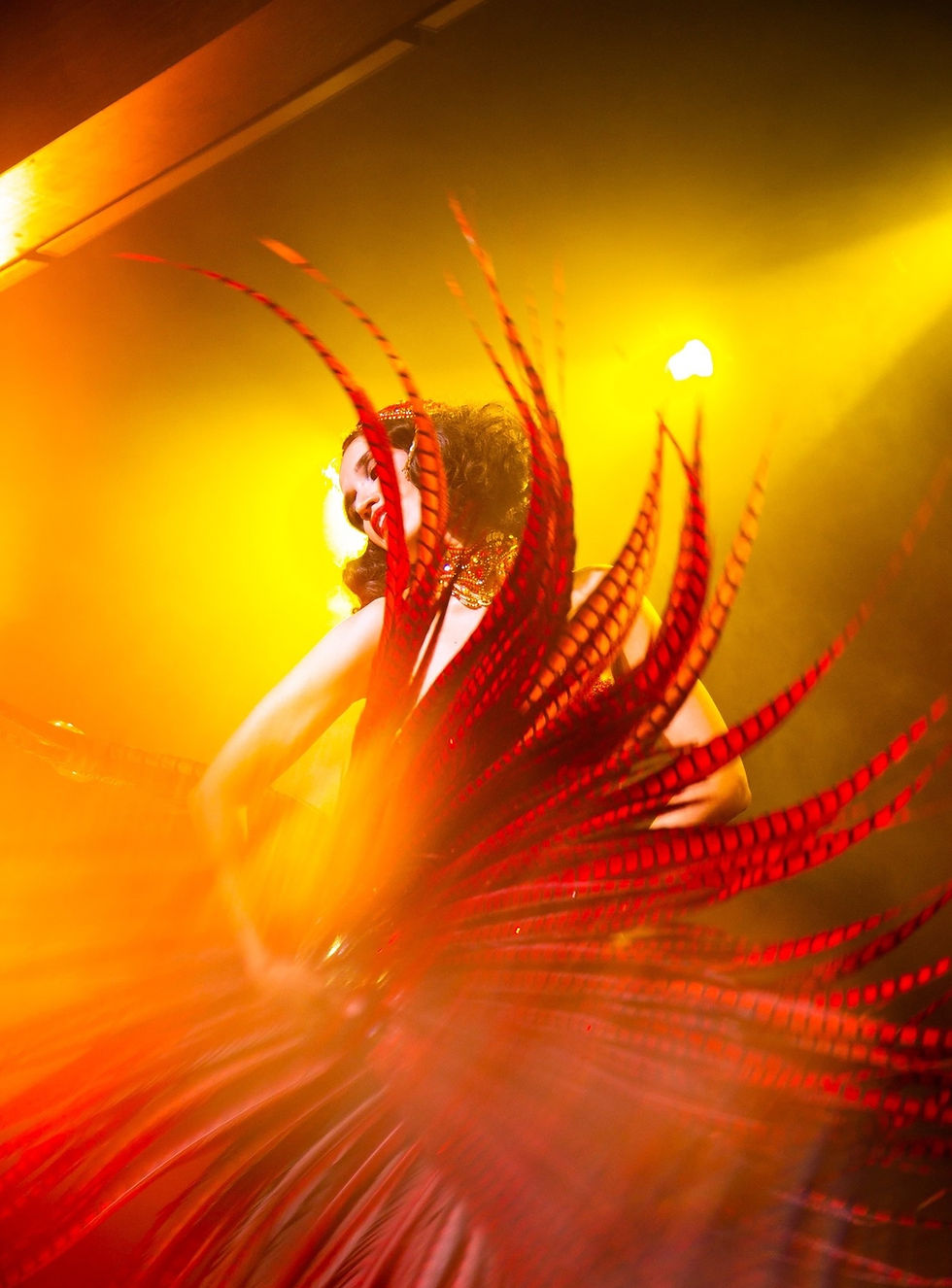
At one point, I had a "Dying Swan" act with huge fans, where I was almost completely naked from the start. It’s a classic number created in America by the dancer Sally Rand. There’s a beautiful legend that she was single-handedly responsible for the commercial success of the 1934 Chicago World’s Fair. She performed with fans – a stunning, petite woman with a ballet background – and people came to see whether she was actually naked behind them.

I used to perform to Shostakovich, and of course, it made everyone cry. I don’t dance to his music anymore, because my career has taken a more commercial direction. Now my acts are built more around costumes.
And speaking of serious art – last year, together with other performers, I was invited to take part in a production of Salome by Richard Strauss at the Semperoper in Dresden. The Dance of the Seven Veils there is performed not by Salome herself, but by six burlesque artists (the seventh is King Herod himself, in a luxurious red dress).
To be honest, I cried with happiness when I received the invitation, because for me it was a dream that had seemed unattainable for most of my life – to appear, with my still rather marginal profession, on the stage of one of the most beautiful opera houses in Europe. And not just to appear there, but to stand at the intersection of the worlds of opera and cabaret.

Tell us about your favourite costumes.
I have two favourite costumes. I made one in the year I met my husband. It was my first time creating something entirely embroidered with beads. The costume is directly inspired by Bakst’s sketches, though it’s not a copy – it’s my interpretation of his style. In the finale, I hold a large glowing moon about a meter in diameter, and at one point it becomes the only source of light in the room. It’s very beautiful and delicate, but I no longer perform it because the costume has started to fall apart. I’m currently working on restoring it in an updated form so I can bring it back to the stage.
The second one, in a Russian style, I made during the pandemic. It contains an enormous number of tiny details that no one but me will ever notice. It features a huge kokoshnik covered in eyes, a dress embroidered with beetles, centipedes, dragonflies, and pansies with eyes at their centres, a bird-like tail made of gilded pheasant feathers, and a corset decorated with twenty different types of beads, rhinestones, and even the wings of real jewel beetles. It’s a luxurious costume, but I’ve decided to perform it less often so it lasts longer.
In February 2022, I also decided that performing a number in a Russian style with a large kokoshnik in Europe would feel, on my part, somewhat insensitive. I don’t want to showcase imperial Russian opulence right now. We’ll see what happens with it in the future – especially since Instagram loves it so much.

Why did the "Russian Seasons" become your inspiration?
I grew up in a house full of books, and among them was an album of Bakst’s sketches. I even brought it with me to Germany, because it’s something sacred to me. Another one of my favourite books is a collection of travel notes describing how Serov and Bakst went to Greece to make sketches, and their rather awkward and very human adventures in a foreign country. It’s amusing to realize that these are great artists, and at the same time two twenty-something-year-old awkward young men.
The "Russian Seasons" are, in fact, very much a community project. It was a group of colleagues who came together to create something, and a certain spirit of the era emerged through the fact that they were all extraordinarily talented. What has always fascinated me most is not the story of a single genius against the crowd, but how friends and close collaborators create together. That is also what we are trying to do with Ladies of Burlesque in Moscow.
I have always felt a strong connection to Diaghilev for this reason – because he gave others the space to shine and create together. Of course, he is a controversial figure, but at the same time he built and sustained this extraordinary world of the "Russian Seasons".

This is a gathering of personalities and stars who are not just "stars" because they were noticed at a ballet academy and promoted. They are independent individuals who wanted to become who they ultimately became. Ida Rubinstein dreamed of becoming a star and an exotic lioness – and she did. Sergei Diaghilev dreamed of making Russian ballet known worldwide – and that also happened. These are all unconventional paths to reaching the peak of artistic realization, which now, through the passage of time, seem almost like fairy tales.
A former ballet soloist from Nancy, Aleksei Von Wosilius, now a burlesque performer, created a stunning act based on The Afternoon of a Faun. In the role of the faun, with hooves, fluffy trousers, and completely covered in gold paint, he looked like a living bronze statue. His interpretation turned out to be even more open and expressive than the original, which was a real revelation for me. Aleksei has an excellent sense of context and a deep understanding of the material, and in some moments you could even notice choreographic quotations from Nijinsky’s choreography. It was incredible!

As I understand, you create your own acts and costumes. How did you end up having to learn all of this?
I never really had to "learn" it, because I’ve been sewing dresses for dolls since childhood. I still sometimes feel that I don’t have any special stage talents – my main talent is stubbornness. Well, stubbornness and charm. And that’s what I built my international burlesque career on. If I needed costumes, I simply had to learn how to make them.
I didn’t have the money to commission costumes in the way I wanted them, firstly. And secondly, honestly, I lack the main resource – and this is something I’m still learning over the years as a burlesque producer – I find it difficult to work with other people. It’s easier for me to do everything myself than to explain something to a craftsperson 300 times, and then make them redo it.
Only recently have I started ordering certain parts of costumes from other makers, simply because my time has become more valuable than money. But I always design everything myself, because it’s my imagination, my dream, and my language – a language I created for myself.
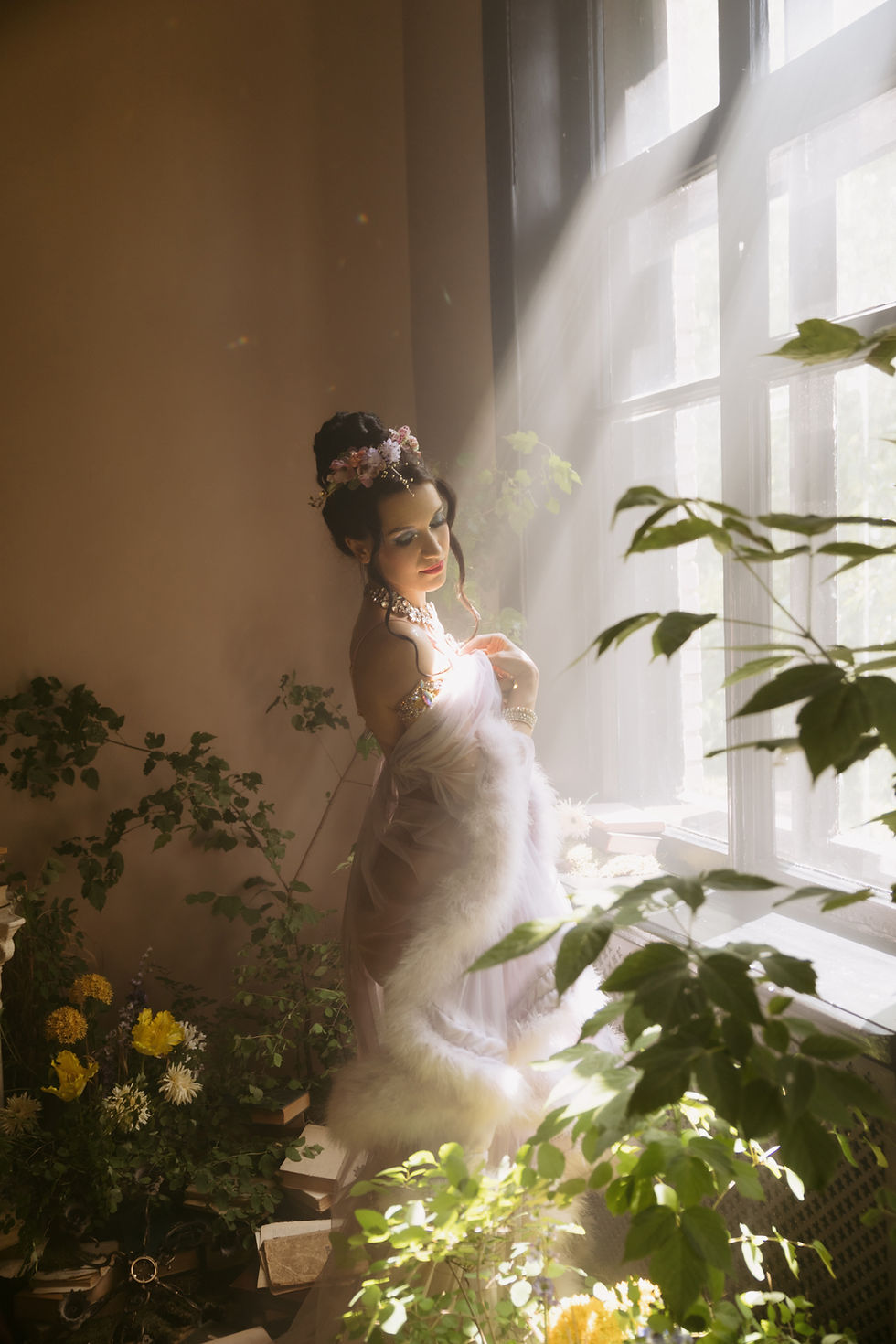
In the past, I was more interested in older things – the Belle Époque, the 1920s – but aesthetically I am now much closer to 1950s musical cinema. That’s why one of my recent acts is a variation on the dress worn by Debbie Reynolds in the 1953 film I Love Melvin.
There is a socio-cultural paradox that doesn’t leave me alone: in 1953, Gentlemen Prefer Blondes and I Love Melvin were released, and in both there is a completely identical scene where an actress in a pink dress sings and dances with men in tailcoats. Both are incredibly beautiful, but completely different. Debbie Reynolds is funny, while Marilyn Monroe is seductive and fatal. That’s when I realized I will never be Marilyn Monroe. I am Debbie Reynolds. There are different types of sexuality, and mine is more tender.
Has there ever been a time when you recreated a number by a famous performer?
I always create very classical and aesthetically predictable things, but I don’t see any point in copying something directly. My first act was a tribute to Josephine Baker, performed to her song, but now I already have enough of my own mythology and ideas.

Do you take care of your health and physical form?
To be honest, I lived for most of my life with anorexia nervosa, and for a long time I struggled with constantly measuring and carefully controlling every meal, eating very little. It took me a couple of years of psychotherapy to deal with it. At some point I simply stopped being anxious and restricting myself – and nothing changed, I didn’t gain any weight at all, but life became incomparably easier.
Now I focus more on staying healthy, because I have a very demanding job – not because I dance a lot (that would actually be wonderful), but because I’m constantly on the move, dragging heavy suitcases, eating on the go, going to bed at 5 a.m. or waking up at 4:30 to catch a flight. That’s why I go to the gym three or four times a week and generally try to stay active every day.
Working in nightlife – whether you’re a musician, DJ, event organizer, or performer – is not a healthy lifestyle. I try to take care of myself simply so I don’t fall apart by the age of 50.
And in Berlin, of course, there are drugs…
Free drugs are actually the real issue, because when you’re an artist, people constantly offer them to you. I personally don’t use them, but I often see their effect on colleagues, and especially on promoters. I remember how in school in the 1990s we were shown terrible educational films about the dangers of drugs (I still remember it was April 1st in 6th grade). I think they left a deep imprint on my psyche, and it took me many years to become more relaxed about other people’s personal choices.
What are you doing at the moment?
At the moment, I have two parallel careers: as a performer and as a producer. The second one is psychologically more important to me right now, because I’ve already been a performer for 15 years, and I feel completely confident in that role.
For my career as a producer, I didn’t study anything formally – neither management, nor accounting, nor how to work with people – but I now remotely run one of the largest cabaret shows in Russia. I don’t really know anything about how to properly run a business, but I do know everything about being a performer. I understand how cabaret shows work simply because I’ve performed in so many of them.
I also have unlimited access to a huge number of colleagues, directors, and producers, and my opportunities for networking and exchange of experience are probably greater than most people’s, which makes this field both more important and more challenging for me right now. Every show I perform in Europe becomes an opportunity to exchange producing experience.
None of this is really visible to others, because even on my show it doesn’t say "Ladies of Burlesque by Anja Pavlova" – because it’s not only my show. It’s a collective effort by many people. I have a wonderful partner and co-producer Taisia, a great team, and we are lucky to work with truly amazing performers.
I suppose I could say that Ladies of Burlesque is the most important and dear project of my life. I love it with all my heart – even in not-so-easy times – and I hope I will be able to continue living both of my dreams for many years to come: as a performer and as a producer.

Journalist: Julia Pneva
Comments