
Anna Bylkova: "The Main Thing Is to Stay Focused and Enjoy the Moment"

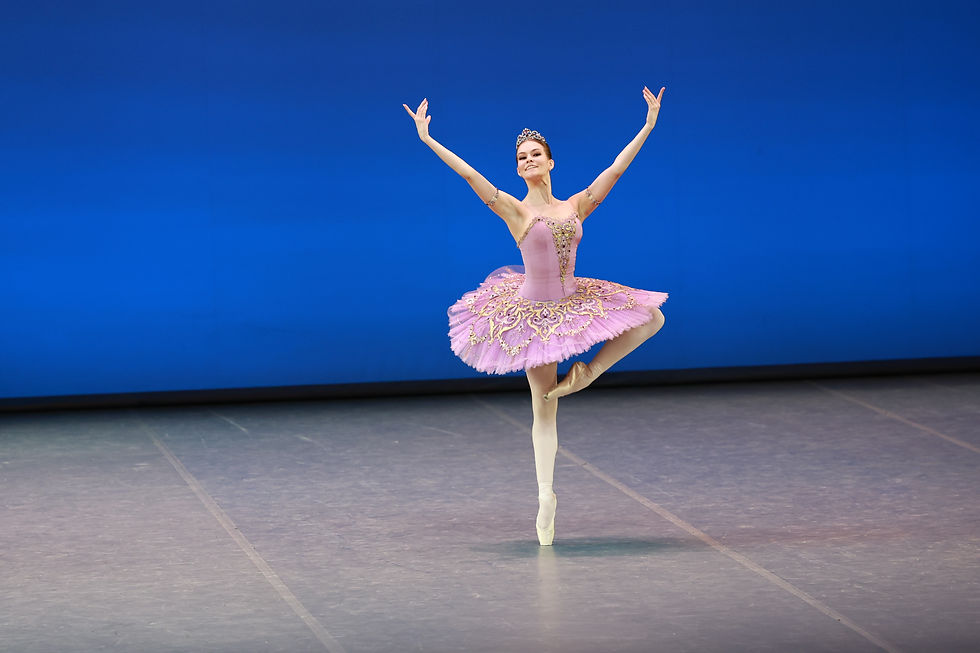
During the first round of the competition, we spoke with Anna Bylkova — a participant from Russia and a student at the Moscow State Academy of Choreography. For young artists, a competition performance becomes a moment of maximum concentration: in just a few minutes, they must demonstrate technique, character, musicality, personality, and the ability to create a complete stage image.
Tell us a little bit about yourself.
My name is Anna Bylkova. I study at the Moscow State Academy of Choreography under the guidance of Tatiana Alexandrovna Galtseva. I represent Russia and the Moscow State Academy of Choreography.
What was most important for you in the first round: technique, role, inner calm, or contact with the stage?
Probably all of it together: creating a complete composition. We performed variations, and in a variation you have to be as focused as possible. Of course, you always need to be focused, but when you go out to perform a variation almost without the chance to "feel out" the stage, immediately entering the atmosphere of the competition, it is very exciting. The main thing is to stay focused and enjoy the moment.

Is there a role or variation to which you feel a special closeness?
First of all, The Sleeping Beauty, the role of Aurora. I danced it at the academy graduation performance. It had been my dream for a long time to dance Aurora. I feel that this role has lived in my soul since childhood: I always dreamed of performing it. And it was at the graduation performance of the Moscow State Academy of Choreography that I finally danced it. I think it suited me very well and turned out successfully.
Is there perhaps another variation or role you would like to dance in the future?
Le Corsaire, which I danced in the first round. Medora is very close to me in terms of energy. I really like her character. Although Aurora and Medora are completely different roles, both are close to me in their own way, and I love them both.
In a competition performance, you often need to show as much as possible in just a few minutes, sometimes even seconds. What is the most difficult thing to convey in such a short time?
Probably the most important thing is to bring everything together: emotional expression, contact with the audience. The energy of the hall is also very important. And in those few seconds, you have to show your whole self, because the jury sees only those seconds. Backstage, there are twenty minutes during the break, little slots when we try something, rehearse something. All of this is done for the sake of going out once and presenting yourself. The stage of the Bolshoi Theatre differs from others because it has a rake.

Was it easier for you because this stage is, in a way, familiar to you, or were there still difficulties with the first entrance?
At our academy, we also have a raked stage, and the theatre stage has one as well. But it was my first time dancing classical repertoire on the New Stage, so of course I was nervous. And the hall is so large — I cannot say that it felt familiar to me. The competition has its own energy and creates a different kind of anticipation. It is not the same as going onstage in a performance or a concert. A competition feels completely different.

What does participating in this competition mean to you?
Of course, I am incredibly happy to be taking part in this competition. For me, it is a great joy to dance on such a great stage. But first of all, it is probably a responsibility. A great responsibility — to represent the Moscow State Academy of Choreography. It is exciting, but you have to work, to gather yourself. The main thing is to dance for yourself and enjoy it.
In Anna’s words, one can especially feel the state that often remains invisible to the audience: behind a short competition appearance stand not only rehearsals and technique, but also inner work — the need to gather oneself, sustain the role, feel the audience, and not lose the joy of dance. For a young artist, participation in the competition becomes not merely a test, but an important stage of professional growth: an encounter with the great stage, with responsibility, and with her own artistic voice.

Journalist: Nina Teseyko
Photo: Stanislav Ivanov
Comments