
"Un Ballo in Maschera" in Berlin: Political Battles On and Off Stage

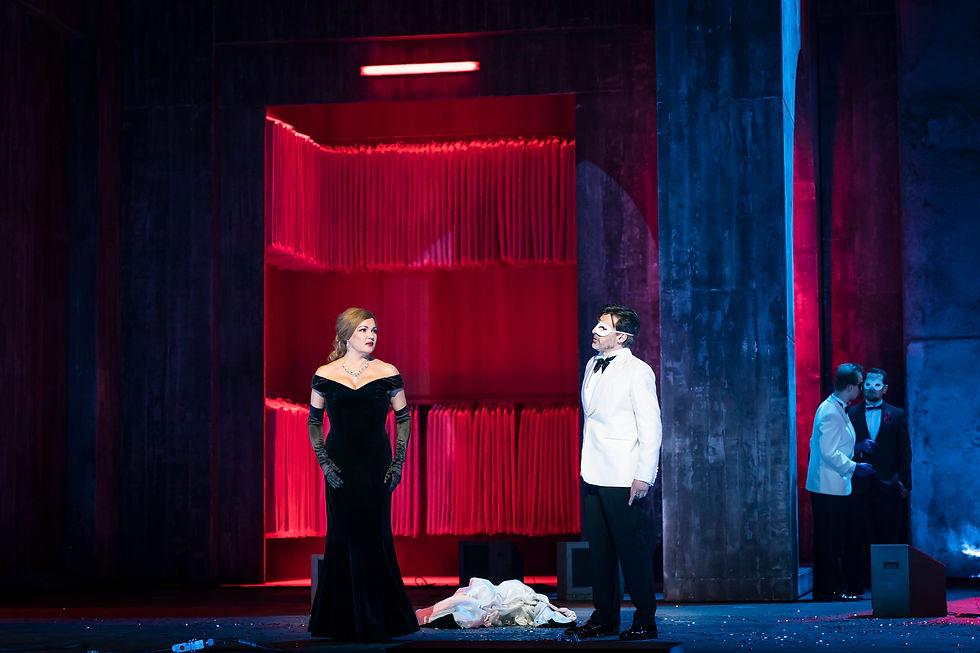
On April 6, the Staatsoper Unter den Linden hosted the final performance of this season’s premiere of Giuseppe Verdi’s opera Un Ballo in Maschera. The production brought together renowned performers, such as Anna Netrebko, Boris Pinkhasovich, and Charles Castronovo.
Yet it was not only the music that captured the audience’s attention. On the eve of the premiere in Berlin, a demonstration was held against Anna Netrebko’s participation: members of the Ukrainian community expressed concern over the singer’s perceived pro-Russian stance. In response, the theater community showed solidarity – indendant Elisabeth Sobotka organized a celebratory evening in honor of the singer after the premiere and in the following days.
Regarding the opera itself, Giuseppe Verdi created a work that stands out in the Italian repertoire. It is one of the few of his operas set in the United States, while the characters are of British origin – a curious combination, especially considering that the opera is performed in Italian.

The plot, however, leaves room for questions.
The central storyline – the love of the main character for his best friend’s wife – is dramatic in itself. Along the way, it becomes apparent that there may have been a past affection or mutual acknowledgment between them that they are trying to forget. Against this backdrop, the protagonist’s surprise that one of his friends might seek revenge feels naïve.
Secondly, the mutual confession between Amelia and Riccardo is presented as a moment where the characters seemingly set aside duty and affirm the triumph of love. Yet the situation appears contradictory: when caught alone at night by Renato in compromising circumstances, they lack the courage to admit their feelings and continue to deny the allegations.
In this context, the ending sounds particularly unusual. The dying Riccardo calls their relationship "pure love" and assures Renato of his innocence. Amelia adopts a similar stance during her husband’s violent confrontation when he is ready to kill her. From a dramatic perspective, such behavior and emotional portrayal feel distant from any sense of genuine, "innocent" love.
In the third place, it is also unusual that Amelia shows little emotional reaction to Riccardo’s death. She does not express grief in a traditional operatic aria, nor does she threaten to end her own life – in essence, nothing dramatically significant happens to her. On the contrary, she prepares to leave with her husband and return to her homeland.
Fourth, for the reasons outlined above, the opera’s ending feels somewhat muted. The focus is on Riccardo’s part, which is more recitative than a true aria. Strictly speaking, it is not a classical aria at all.
The choral scenes, however, both in the finale and at other key moments, are truly impressive: their combined sound creates a powerful musical fabric, shifting between ominous, tragic, and suspenseful moods.

From a musical standpoint, Un Ballo in Maschera is one of Verdi’s strongest operas. At the same time, it noticeably differs from his famous "trilogy" – La Traviata, Il Trovatore, and Rigoletto. Here, the composer moves toward the French grand opera style, expanding both scale and dramaturgy, while retaining recognizable Italian melody and emotional expressiveness.
As for Rafael Villalobos’ production, the opera was set into a current-day context. This choice proved unexpectedly effective: the plot, centered on the main character’s political career, resonates with contemporary reality and even evokes associations with current events, including the figure of Donald Trump. This is a rare case where modernization enhances rather than distracts, helping the audience better understand the onstage events.
The musical part of the performance deserves a special credit. The orchestra, chorus, and soloists demonstrated a high level of skill, and the theater’s acoustics allowed the audience to fully enjoy the opera’s sound.

Particularly noteworthy was Anna Netrebko as Amelia. Her performance displayed subtle dynamics, emotional depth, exquisite pianissimo, and rich chest tones. During climactic moments, the audience literally held its breath, and the end of her arias was met with enthusiastic ovations. Her voice was full, rich, and thoroughly fresh.
Anna Kissjudit, performing the role of Ulrica, also made a strong impression with her deep, resonant lows – a traditionally contralto part rendered especially convincingly.

Charles Castronovo demonstrated not only vocal mastery but also expressive acting. Their trio with Amelia and Ulrica was particularly memorable – a rare example of ensemble singing where the voices blended seamlessly.
Boris Pinkhasovich also left a strong impression with his beautiful, deep, and even voice. His baritone sounded confident, noble, and cohesive, without the slightest strain, filling each phrase with inner strength and expressiveness.
The performance as a whole was successful, showcasing a precise and relaxed directorial concept. The production maintained steady, restrained pacing and careful attention to musical detail, creating a cohesive and harmonious impression. Yet, despite its professionalism and polish, it feels more like a worthy interpretation than an event likely to leave a truly deep and lasting mark on the audience’s memory.

Text: Julia Pneva
Photo: Stephan Rabold, Staatsoper Unter den Linden
Comments