
Bayreuth Festival: Wagner, AI, and a Test of Endurance
Updated: Aug 15

Bayreuth is marking the festival’s 150th anniversary with an experiment: the new Ring transports Wagner into a world of AI, projections, and an almost complete rejection of traditional stage action. But can technology replace dramatic tension? After Das Rheingold and Die Walküre, Julia Pneva, editor-in-chief of Voci dell’Opera, was left with more questions than answers — and one of the most unexpected is this: if all that remains on stage are singers and visual projections, does the opera risk becoming a concert performance with video accompaniment?
Day One of the Bayreuth Festival. And the first challenge is the theatre itself.
I honestly had no idea that the Festspielhaus would be so enormous. My first impression was actually quite strange: it reminded me more of a railway station or some old courtroom than a theatre.
Inside, everything is very austere and historic. Wooden seats, incredibly narrow rows — you are literally sitting shoulder to shoulder with the person next to you. It is difficult even to turn around, and for your back, it is a real test of endurance. The auditorium is also surprisingly hot and stuffy. I honestly wonder how elderly people manage to sit here for five or six hours.
Yesterday was only the prologue — Das Rheingold, about 2.5 hours without an intermission. Today is Die Walküre — already around 5.5 hours, although there are two intermissions. And the final day will be even longer — around 6.5 hours.
The theatre itself is also located on a hill, so even getting there feels like part of the challenge.
There is another completely unique feature of Bayreuth: the orchestra is hidden beneath the stage, in the famous Wagnerian orchestra pit. The audience can barely see it.
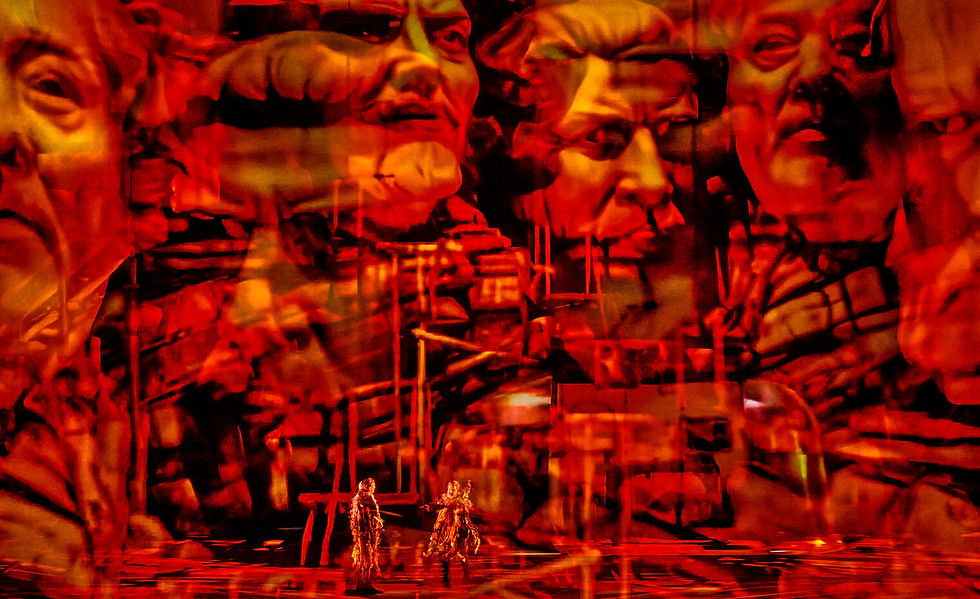
This year, Ring is staged with extensive use of artificial intelligence and is titled Ring 10010110. The visual component is built almost entirely around constantly changing images.
I cannot say that I disliked the production because of AI. Sometimes the images were genuinely beautiful; at other times, their quality looked rather strange. But that was not really the problem.
I was bored.
The singers tell the story while visual images constantly change around them, but there is very little stage action — in fact, one could say there is virtually none. Although perhaps Rheingold was not the easiest material for such an experiment. It is the prologue to a much larger story, and perhaps this format particularly emphasized its narrative character.
So I am not ready to deliver a final verdict yet.
Another strong impression was the audience’s reaction. The singers received an incredibly warm response: loud applause, countless "bravos", and tremendous support. The production, however, was literally booed and hissed after the final curtain. And it was very loud. It seems to me that audiences in Berlin are much more restrained when expressing their disapproval.

Day Two. Die Walküre
I had a faint hope that Die Walküre in Bayreuth would at least be different from Das Rheingold. But no.
The same singers stand almost completely motionless on stage, with projections instead of scenery and virtually no props. And the costumes… I am still trying to understand their concept.
Gods, heroes, women, men — everyone looks so similar that at times I literally stopped understanding who I was looking at.
I understand the idea: this year, Bayreuth has decided to experiment and use AI as part of its theatrical language for the first time. But then I have to ask: if stage action, scenery, and props have been almost entirely abandoned, why not simply call it a concert performance with visual accompaniment?
And there is another thought I cannot shake.
The Bayreuth Festival is celebrating its 150th anniversary. And in precisely this anniversary year, we are experimenting with staging the entire Ring cycle. Why?
I completely understand that a festival has to evolve. Contemporary theatre should search for new forms. But if you really want to experiment, why not choose Rienzi, Der fliegende Holländer, or another individual Wagner opera for that purpose? Why, precisely now, in the festival’s 150th-anniversary year, completely reinterpret the Ring — a work so deeply connected to Bayreuth’s own history? Especially when the result leaves little more on stage than singers, lighting, and projections.

And there is one more question: why are there no subtitles in Bayreuth?
More than four hours of Wagner in German, a complex text, mythology, long dialogues — you either have to know the libretto practically by heart. It feels especially strange today, when subtitles have long become standard in opera houses.
I understand Bayreuth’s historical character. But if the festival wants to be modern and experiment with AI, visual language, and theatrical form — perhaps it could start by making it easier for the audience to understand what is happening on stage?

There is another feature of Bayreuth that you need to be prepared for: a Wagner opera can last around six hours, which means the evening performance starts as early as 4 p.m. And, of course, that is the hottest part of the day — blazing sun, heat, and several more hours ahead in the theatre.
It is cooler inside than outside, but after several hours of sitting, the stuffiness is still noticeable. The intermissions are long: the first is about an hour, the second around 45 minutes.
The festival’s organization, however, pleasantly surprised me. There are an enormous number of places selling food, drinks, ice cream, and beer — and there are hardly any queues anywhere. Plenty of entrances, exits, and toilets.
Around the theatre, there is a beautiful park with a lake, sun loungers, and even activities inspired by the Ring.
There are also stations where you can leave your shoes for free and change into another pair. And that is particularly useful: the Festspielhaus stands on a hill, and after several hours of Wagner, walking downhill in heels is a challenge of its own.
I did not try the Ring-themed escape room. For now, I need to prepare my own. 😅

Text: Julia Pneva
Photo: press department of the Bayreuther Festspiele
With all the drama of this year, the most important thing to remember? The most important thing was Wagner himself said.
“ Kinder shaft Neu”. WAGNER HIMSELF SAID MANY TIMES THE FUTURE WILL CHANGE EVERYTHING. CHILDREN CREATE NEW.
With Wieland and Chereau, ETC.