
Competition through the eyes of the participants: Auguste Marmus and Rachel Pimentel Quintão on the Bolshoi Stage, Competition Nerves, and Dream Roles

We spoke with Auguste Marmus and Rachel Pimentel Quintão about what it means to step onto the stage of the Bolshoi Theatre, how a competition performance differs from a regular production, how to find a balance between technique and artistry, and which roles they dream of performing in the future.
How do you feel in Moscow, on the legendary stage of the Bolshoi Theatre, and at the XV International Ballet Competition in general? Was this a dream of yours?
Auguste Marmus: This is a very prestigious competition, and it is a great honor for us to take part in it. I think many participants dream of dancing at the Bolshoi Theatre. The very fact that we are stepping onto a stage where so many stars have danced is more than I could have asked for.
Rachel Pimentel Quintão: I agree. For me, this is one of my first major competitions, so it is a very special experience. Together with our teacher, we decided to come here in order to challenge ourselves, perform, and work on different pas de deux.
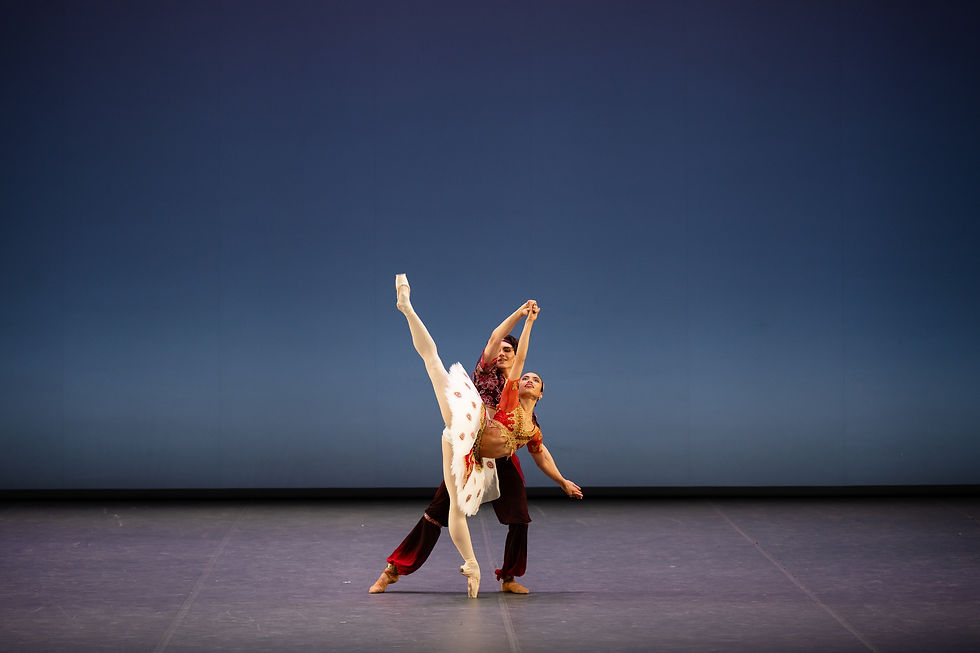
How do you find the balance between the technical and artistic sides of a competition performance?
Auguste Marmus: Technique is something we work on every day in the studio. Every day, you can improve something. But artistry comes from within; it is something you can offer the audience more freely. These things are connected, but they are different. You cannot work only on technique and forget about artistry.
In the end, the audience comes to the theatre for emotion, for a beautiful image that will stay with them after the performance. I do not dance like a robot. I dance because I love it, and I want to share that love with the audience. I think this is where the balance appears.

Is it more difficult to go on stage in a competition than in a regular performance?
Auguste Marmus: For me, absolutely. Last season, I had the opportunity to dance leading roles in performances, and that is a completely different experience. A full-length ballet is a marathon: it is physically very demanding, but you have time to gradually build a connection with the audience.
In a competition, everything is different. You have only a few minutes, sometimes literally seconds, to show yourself and convince the audience that they are seeing something special. A mistake becomes more noticeable, and there is much less time to reveal yourself. That is why a competition is, in many ways, more stressful.
But it is also a good challenge. It pushes you to work a lot, to try different pas de deux, different styles and characters.
After long rehearsals, does stepping onto the stage feel like a reward?
Rachel Pimentel Quintão: Yes, of course. After so many rehearsals, stepping onto the stage always feels like a reward.
Do you have any rituals before going on stage? What helps you get into the right state of mind?
Auguste Marmus: I need to knock on the floor three times. That is my ritual. It is more that I have a certain mindset before going on stage. I think about doing everything I can, enjoying it, and leaving the stage with a sense of satisfaction.
Rachel Pimentel Quintão: Sometimes it happens like this: if I ate something specific before a good rehearsal, and then the rehearsal went well, I start thinking that before the next performance I need to eat the same thing.
Do you have a dream role? What would you like to perform in the future?
Auguste Marmus: For me, the role of Ali in Le Corsaire has been a dream since childhood, probably since I was ten. I watched a lot of videos, almost obsessively. It is a very beautiful role, with wonderful music. I am also interested in Solor in La Bayadère. In general, there are many roles I would like to explore.
Rachel Pimentel Quintão: For me, it is Kitri. I would really love to dance Kitri. But not necessarily at a competition. I think the entire ballet Don Quixote must be incredibly interesting: it is energetic, joyful, and at the same time very difficult.
How did you choose the repertoire for the competition?
Auguste Marmus: We approached the choice strategically. If we had needed to prepare one or two pas de deux, we might have chosen something we simply love very much: for example, Don Quixote or Le Corsaire. But when you need to prepare many pas de deux, it is a huge amount of steps and choreography that both the body and the mind have to withstand.
During rehearsals, we could do two or three pas de deux in a row in order to keep the choreography in our memory and maintain our physical form. If we had chosen only based on “what we like,” I think it might have turned out to be too heavy.
You prepared a fragment from the ballet Spartacus. What does working with this choreography mean to you?
Auguste Marmus: If we speak about dream roles, then Spartacus is a special story. The music, the whole ballet — everything about it is very powerful. But working on this choreography was not easy, because here Yuri Grigorovich is regarded as a legend, and the entire competition is dedicated to him.
We did not have much experience performing his choreography, and it is not easy to find people who can stage it precisely. That is why we really hope to receive advice here and to feel his style more deeply — the character of the steps and movements. So far, we have largely learned from videos and tried to reproduce the material as accurately as possible.
For Auguste Marmus and Rachel Pimentel Quintão, the competition became an opportunity not only to step onto the stage of the Bolshoi Theatre, but also to test themselves in different styles, characters, and working tempos. They speak about the competition as a challenge that demands complete concentration, but precisely because of this, it gives a sense of growth — both professional and inner.

Interview by Nina Teseyko
Photo by Stanislav Ivanov, press department of the competition
Comments