
Final Act in Munich: Julian MacKay Dismissed, but Unbroken
A look at what we know so far about the scandalous dismissal of the Bayerisches Staatsballett’s former principal, whom to believe in a situation like this — and, along the way, a rebuttal of the rumours now making the rounds.
While ballet companies around the world are gently winding down the 2025/26 season, on Monday morning the Bayerisches Staatsballett dropped what can only be called a bombshell on balletomanes everywhere. On 13 July the theatre published the following post on its official Instagram:
"Julian MacKay and the Bayerisches Staatsballett are parting ways with immediate effect. The Principal Dancer is leaving the Munich company today, 13 July 2026. We would like to thank Mr. MacKay for the past four years and wish him all the best for the future."
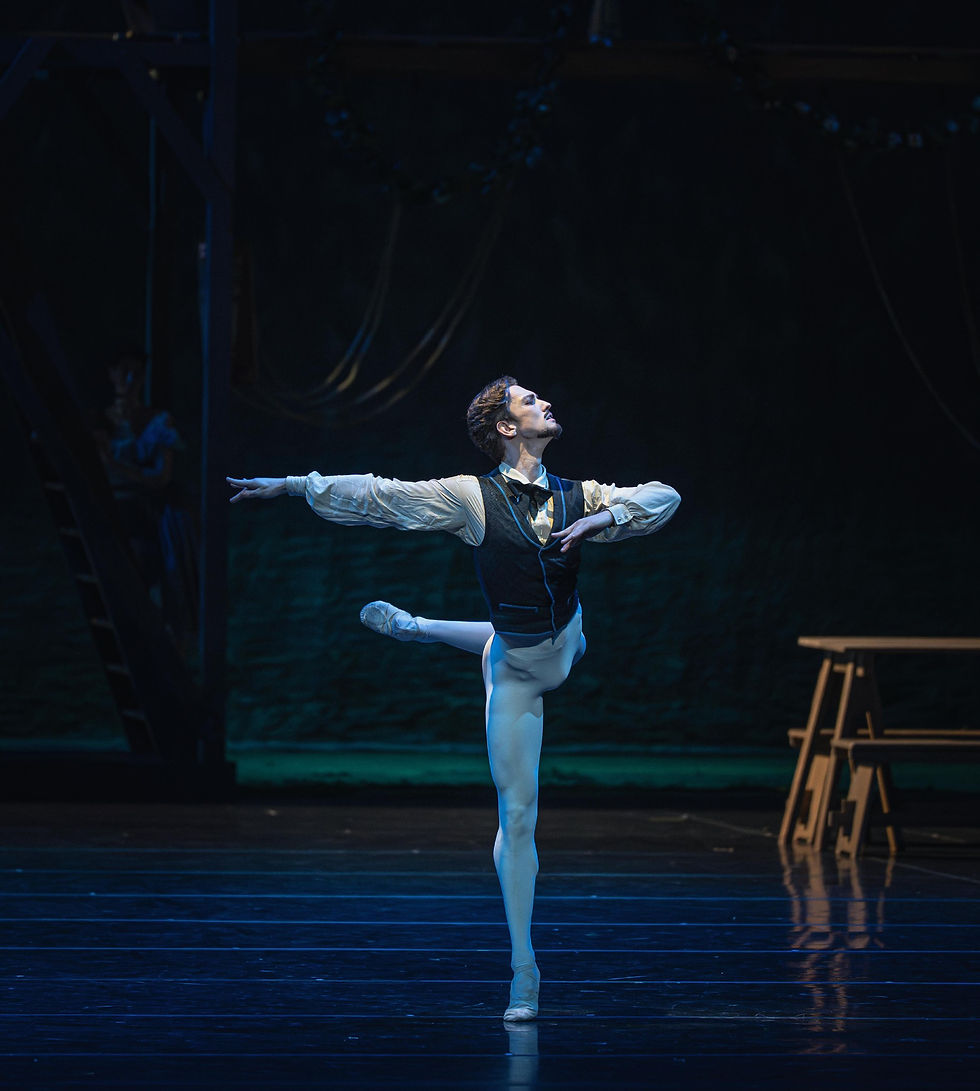
From the very wording of the post it was immediately clear: something had happened. Even that final line, given the overall tone, rings formal and insincere. As a rule, when you genuinely wish someone well, you don’t announce their dismissal to the whole world — and you don’t do it overnight, a couple of days before the season ends.
So what happened? The answer wasn’t long in coming. Within an hour, Julian MacKay himself gave his version of events:
"After four years, I have been dismissed. I am shocked to have found out through Instagram. After I raised concerns about what I considered improper conduct and unfair treatment within the ballet company, I asked the theatre’s management to look into it — or else I would resign myself. Instead, this morning I was dismissed with immediate termination of my contract, while I was on sick leave. This is no way to treat artists, and I will not stay silent about abuses in my industry. I also find it telling that the comments under today’s announcement, made without my knowledge, have been switched off."
When the theatre hastened to refute the dancer’s words — adding a note that MacKay had in fact been told of his dismissal in person, at a morning meeting with management that same day — the story ended up with more questions than answers. Whom to believe? Who is right? Who is to blame? But the real question is a different one: why?
Why would the Bayerisches Staatsballett announce, in such brutally public fashion, that it was parting ways with the biggest star of its company? Why, in a situation where neither side is permitted to comment, hand the public such fertile ground for speculation? Could a conflict invisible to outsiders really not have been resolved quietly and amicably?

The reputational damage to both sides was instant. Some immediately took MacKay’s side — you can see it plainly in the comments under his post, where words of support come from audiences and dancers alike, while several of his Bayerisches Staatsballett colleagues reposted his statement to their own Instagram stories. Others, on the contrary, began dredging up all of MacKay’s alleged “sins” — a supposedly difficult character, say, or excessive emotionality. As though a strong character and the willingness to stand up for oneself were grounds for dismissal — or automatically proof that the dancer is in the wrong in every conflict.
And so, in 2026, for a dancer to voice an honest opinion, to defend personal boundaries, to point out management’s (alleged) mistakes — remains an enormous luxury. Anyone with a heightened sense of justice is promptly filed away as a troublemaker. The ballet world, it seems, still prefers quiet, compliant employees to stars who sell tickets and command an Instagram audience 3.3 times larger than the theatre’s own.

The very wording of MacKay’s dismissal likewise gave plenty of fuel for speculation online. In comments and blogs, people wonder: “If he was fired this abruptly and overnight, he must have done something terrible?!” Did he show up drunk? Was there violence? Or something worse still? The imagination of online commentators knows no bounds — even when every one of these versions sounds absurd, and the dancer’s reputation is spotless…
Meanwhile, since that scandalous post, the Bayerisches Staatsballett has offered only one further comment. According to a theatre spokeswoman, MacKay’s criticism concerned above all the casting policy of the ballet director — Laurent Hilaire. If we take that wording at face value, this is not about some grave misconduct, but about something rooted deep in the working relationships within the company.
That spare formulation might have been expected to cool the speculation. But the opposite happened — for want of detail, people began filling in the blanks. A version of the conflict conveniently favourable to the theatre started circulating online. Supposedly the whole affair comes down to the dancer’s wounded pride: in one performance MacKay didn’t get the coveted role of Armand in “The Lady of the Camellias,” and couldn’t come to terms with it. There you have the entire conflict: a capricious star, aggrieved over a role that, on top of everything, supposedly doesn’t even suit him. A version seductive in its simplicity — but look a little closer and it doesn’t hold up.

Let’s begin with the fact that the Bayerisches Staatsballett gave "The Lady of the Camellias" only six times this season. Three lead casts took part in the run: Laurretta Summerscales — Jakob Feyferlik, Ksenia Shevtsova — Julian MacKay, Elisabeth Tonev — Osiel Gouneo. All three casts were approved personally by John Neumeier — which makes doubting whether the role of Armand suits Julian MacKay foolish at best and disrespectful at worst. And here is what’s telling: unlike the first and third casts, who danced roughly the same number of performances, the Shevtsova–MacKay pairing went on only once — on 13 May, for their own premiere. What’s more, the performance closed to a standing ovation, and both dancers were dazzling in their roles, unfolding a whole palette of complex, finely shaded emotion.
And here arises the question that the whole "capricious star" narrative so neatly sidesteps: if the pair danced their premiere brilliantly, sustained no injury and had no visible reason to drop out of the run, then why was it precisely this pairing that was never brought back onstage? For the record, Shevtsova and MacKay were slated for 10 July — the dancer even announced it on his Instagram. But that same day the cast was pulled, and MacKay later had to put out a new post — saying he would no longer be dancing Armand after all.
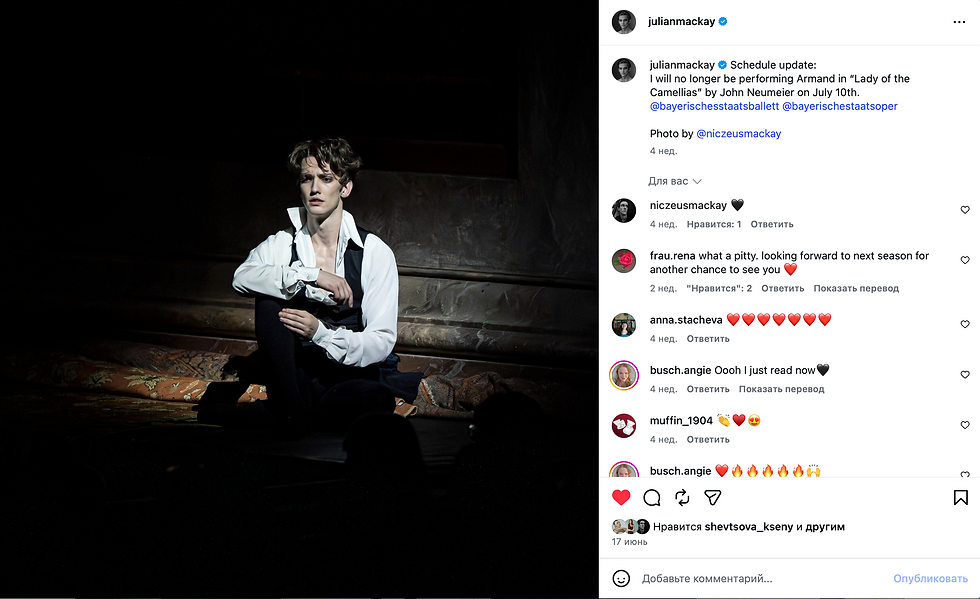
So what really happened? An aggrieved dancer denied a role? Or a director who, for reasons unknown to us, is sidelining one particular cast? Draw your own conclusions.
And here we come, perhaps, to the central question of this whole story: not "who is right," but whom to believe, when both sides stay silent on the substance and the public is left to reconstruct the truth from scraps of posts and cautious press releases.
As we see it, in any vertical relationship the default should be to believe the weaker party to the conflict, until proven otherwise. And this is not about personal sympathies, but about the sheer asymmetry of the employer–employee relationship. Dancers, sadly, like most wage earners the world over, cannot dictate the terms of their contracts. More often than not it is a contract of adhesion: you either take it whole, or you’re left without work. That is how the labour market is built. A ban on public comment? We sign. A dispute clause weighted in the employer’s favour? We agree.

That is precisely why, when a conflict erupts, the forces are unequal from the outset: on the theatre’s side — lawyers, PR, money and the right to speak first; on the artist’s side — only his own voice on social media. It is no accident that labour law the world over, in Germany as in Russia, proceeds from the premise that the employee is the more vulnerable party and requires special protection. So why should we, as spectators and commentators, assume the opposite?
And this enforced silence works in one direction only. MacKay’s colleagues and friends are bound by the same contractual obligations and cannot speak up in his defence. The theatre, meanwhile, having spoken first and publicly announced the split, promptly took cover behind a convenient "no comment." The silence imposed on a dancer and the silence chosen by an institution are of very different weight.

Incidentally, Julian MacKay has already said he intends to challenge his dismissal as unlawful. And beyond public opinion and the logic of labour law, such cases have a rather encouraging track record in the German theatre world. In 2022, for instance, the music director of the Stuttgart Ballet, Mikhail Agrest, contested his dismissal before the specialist arbitration court for stage professionals (Bühnenschiedsgericht) in Frankfurt — and won: the court declared the termination of his contract invalid, and the theatre had to seek a reconciliation. And a year earlier, the Staatsballett Berlin dancer Chloé Lopes Gomes secured financial compensation through a claim against her own company, which she had accused of racial discrimination.
None of this, of course, means that MacKay is telling the whole truth and the theatre none of it. The point is different: as long as no one knows the truth, it is fairer to err on the side of the one with less power. And even if MacKay fails to overturn the legality of his dismissal, he still has grounds to seek compensation — for the manner in which he was sent off. Just consider how this farewell looks from the outside, to other theatres, where the very same spectators and commentators as us are already primed to fill in the reasons for such ostentatious coldness.
It is hard to imagine either side emerging from this as the winner. To Julian MacKay we wish for the strength to conquer new heights. And the Bayerisches Staatsballett would wish for an ethics commission and a mediation service — so that, in future, it might come through any quarrel with its head held high, and without a trail of hateful comments on social media.

Photo: Nicolas MacKay
Journalist: Margarita Makhrina
Comments