
Ksenia Shevtsova: "Choreography is the stylistic philosophy of your body"
Updated: Jun 18
Ksenia Shevtsova — on her debut in The Lady of the Camellias, working with John Neumeier, a dream featuring Diana Vishneva, and the sauna culture of Germany

On 12 May, The Lady of the Camellias returned to the Bayerisches Staatsballett after a six-year absence. In the intervening years, the company changed its artistic director and welcomed a new generation of soloists — for many of them, this run of performances marks a premiere.
We spoke with Ksenia Shevtsova — principal dancer of the Bayerisches Staatsballett (and guest soloist of the Stanislavsky Theatre) — about working with John Neumeier, preparing the role of Marguerite Gautier, and life in Germany.
Over your two seasons in Munich, this is already your third role in a Neumeier ballet — after Louise in The Nutcracker and Princess Natalia in Illusions — like Swan Lake. These are very different works: a fairy tale, the dreamworld of a sick king, and now Marguerite, who does the opposite — she refuses all illusions. What does Neumeier's choreographic language mean to you?
KS: I've known Neumeier's choreography for a long time — from my years at the Stanislavsky and Nemirovich-Danchenko Theatre, where The Little Mermaid, The Seagull and Tatiana were in the repertoire. His dance language is complex, with many intricate lifts and catches. But what always matters most to him is the emotion you invest in a movement, not how cleanly you execute it — a turn of the wrist, say. The same lift can look entirely different with different casts and different partners.
In Illusions — like Swan Lake I danced with Jakob Feyferlik, Osiel Gouneo and Julian MacKay — and the result was three completely different productions. I love searching for new colours through different partners, but there's a downside: everyone refers back to John and to what he said at some point. The thing is, he gives notes specific to each particular duo and each particular dancer — what works for one pair simply may not work for another.

Ksenia Shevtsova and Jacob Feiferlik in Illusions — like Swan Lake | photo by Katja Lotter
So where does the real difficulty in his choreography lie — if not in the technique?
KS: Sometimes you learn something in isolation — Marguerite's solo from The Lady of the Camellias, for instance. You think there's nothing technically demanding about it, but when you start putting everything together and adding the emotions John asks for, you can no longer do it as cleanly. The most important thing is to build your own through-line in the performance and carry the choreographer's idea — so that the audience reads it, rather than simply watching a clean arabesque set to music. Emotions and an understanding of the movement actually help you dance his choreography. Sometimes you and your partner are struggling with a lift, and then Neumeier arrives and explains what you should be feeling at that moment. From the outside it looks as though you simply need to rise and hold your leg — but it's the opposite. It's a sharp intake of breath, or a release. Understanding the emotion and John Neumeier's intention makes the movement easier to execute and helps you find the meaning of what is happening. And sometimes — the meaning of yourself.

Ksenia Shevtsova and Julian MacKay in The Lady with Camellias | photo by Nicholas MacKay
Could you share what notes John Neumeier gave during the preparation of The Lady of the Camellias, and how important it is to prepare such a major role with the Maestro himself?
KS: Unfortunately, we had very few rehearsals overall. There wasn't even a full run-through on stage — for the theatre, this is a revival, not a premiere. But for us personally — for my partner in this production, Julian MacKay, and me — it was a major premiere.We worked in extremely compressed conditions. We stayed in the studio on our own every day after rehearsals and came in almost every weekend to make up for the time we didn't have. With John Neumeier, there were just two rehearsals — right before the premiere. But even those two rehearsals put everything in its place…
In The Lady of the Camellias there is a raised platform with steps on stage, and during rehearsal John told me that I could fall to the floor as I ran into the room during Marguerite's coughing fit. In the story, Marguerite is dying of tuberculosis, and my fall was meant to show the violence of the attack. That detail John suggested adding for me specifically. In another moment I made a small mistake — I stumbled and grabbed the proscenium (the front section of the stage, closest to the audience, in front of the portal and curtain — Ed.). John liked what I did with it, so he asked me to keep it and even told the other casts to do the same.

Ksenia Shevtsova and Julian MacKay in The Lady with Camellias | photo by Nicholas MacKay
At the same time, certain nuances — like the convulsive coughing fit — he adds for some performers and not for others. Neumeier worked with our individual temperaments and differences: each of us is a living part of the production. It is so important to establish your own emphases together with the choreographer — not the role as you imagine it yourself, but the way he sees that line within the work. Of course, we all bring something of ourselves, but even if you are a strong individual, I think it matters to stay within the bounds of the choreographer's vision.
That's fascinating — the ballet goes on living, and you become part of it. At the final rehearsal, during the Black pas de deux (the farewell duet of the two leads in the third act — Ed.), John told us that one particular lift had originally been conceived differently, but at some point everyone began doing it another way. And that note was given only to Julian and me. Meaning that even the other casts in our theatre will dance it differently. So these details matter enormously — and please don't think Ksenia Shevtsova changed the order herself (laughs).
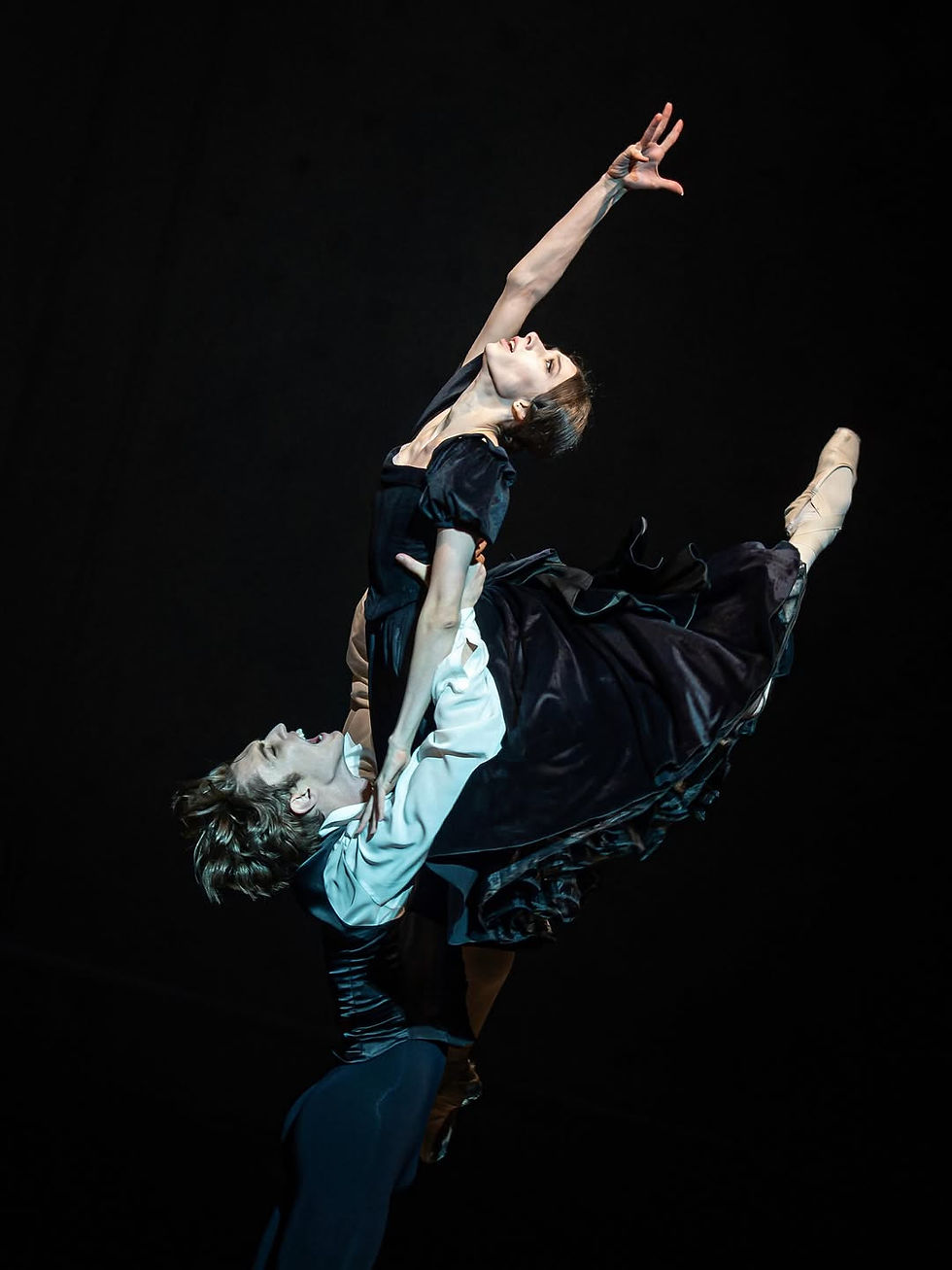
Ksenia Shevtsova and Julian MacKay in The Lady with Camellias | photo by Nicholas MacKay
Besides Neumeier himself, the production team includes répétiteurs who once danced in The Lady of the Camellias. Who did you work with, and what does that kind of direct transmission — body to body — from those who have stood in these roles before you give you?
KS: We worked with Marijn Rademaker (formerly a principal with Stuttgart Ballet and Dutch National Ballet — Ed.). I remember at our first rehearsal he began demonstrating both Armand's and Marguerite's parts. I was struck by how perfectly he transformed — not just in his face, but in his whole physicality. The way he embodied both leading roles gave us an immediate understanding of the quality and the emotion of each movement. He explained everything with great clarity and precision, and gave meaning to every step. For example, there's one movement in the ballet where you think — well, it's just an arm and a leg. But he explained that in this moment the character is saying: "I love you with my whole body." And you have to show that in the dancing. Not just touch your hand to your leg, but convey to the audience that Armand loves Marguerite from head to toe.

Ksenia Shevtsova, Julian MacKay and Marijn Rademaker | photo by Nicholas MacKay
At that same first rehearsal, when Julian and I were dancing the White adagio (the central pas de deux of the second act — Ed.), Marijn caught our gazes and told us to remember them. He asked us not to add anything, not to act — just to leave everything as it was, our natural chemistry. On one level you think as a performer: "What do you mean? I'm supposed to be playing something!" But I've noticed from my own experience that the more you look into your partner's eyes, the sooner you arrive at an honest story together.
This matters, because today people so often focus on how high the leg is in the arabesque, or on the cleanness of the lines, rather than on the idea, the character, the emotion. When that happens, the magic — the spark — is lost. For me, choreography tells a story and carries emotion above all else. Otherwise, what is it all for? So I wasn't overly troubled that not everything was perfect or clean at the premiere of The Lady of the Camellias. What mattered was that emotionally, we were honest — with ourselves and with the audience.

Ksenia Shevtsova and Julian MacKay in The Lady with Camellias | photo by Nicholas MacKay
You've spoken before about being inspired by Altynai Asylmuratova and Yulia Makhalina while preparing Swan Lake. This time, did you draw on any particular performers, or were you looking for your own interpretation entirely?
KS: I always watch a great deal of video. I find it fascinating to see how different ballerinas interpret and inhabit the same choreographic text. This time I watched Svetlana Zakharova, Marcia Haydée, and I was very taken with Silvia Azzoni. And we also had Ivan Liška dancing at our premiere — in the role of Armand's Father (former Artistic Director of the Bayerisches Staatsballett and principal dancer with Hamburg Ballet, who collaborated with Neumeier for over twenty years — Ed.). That was a real gift. He has lived such a journey with this ballet. The role of Armand Duval was created on him, and now, all these years later, he came back as Armand's father. It's his own story within the story — it adds depth and drama to the whole production. That's what's so interesting about John's work. You can see Liška dancing with Marcia Haydée in the canonical film recording of the ballet.
That said, I never try to copy other ballerinas. When John Neumeier arrives, he gives his notes to you specifically and shapes the role out of you. I observe — I watch how other ballerinas channel the ballet through themselves. I find inspiration, but I can't allow myself to copy. I'm working with real people, with rehearsal assistants who bring their own corrections. You simply can't copy from a video. But for the sake of inspiration, I watch others with pleasure.
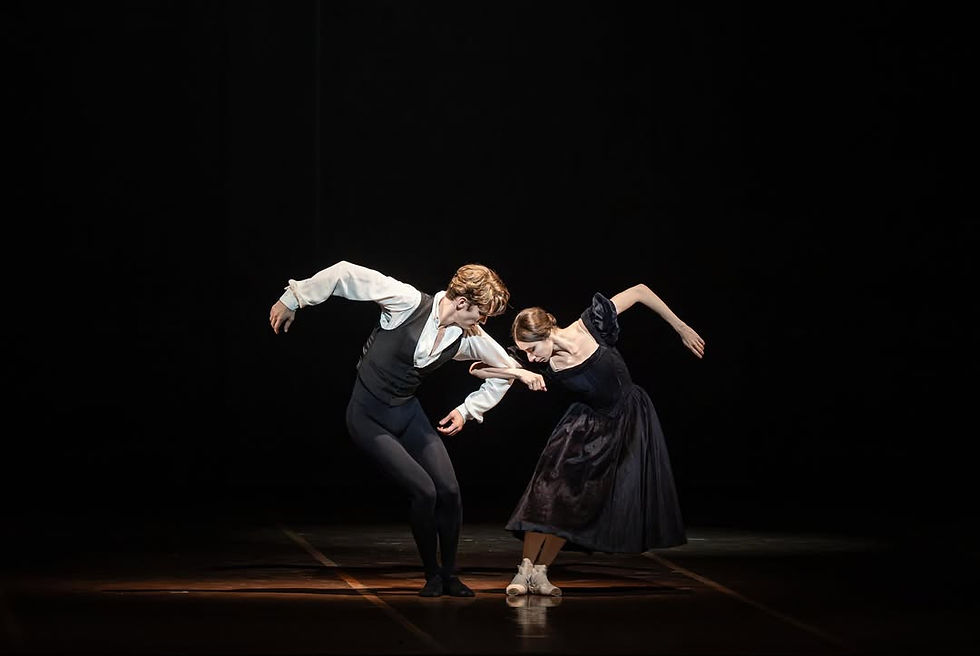
Ksenia Shevtsova and Julian MacKay in The Lady with Camellias | photo by Nicholas MacKay
I very much wanted to find a recording with Diana Vishneva, but unfortunately never did. And yet Diana became, in a way, my guardian angel before The Lady of the Camellias. The night before the premiere I couldn't sleep — I was anxious about not being sufficiently prepared, and there are so many mise-en-scènes in the ballet that I kept running through the order in my head. I couldn't get past the theatre scene (the opening scene of the first act — Ed.). And then, close to morning, I had a dream: on the day of the performance, Diana Vishneva comes to the rehearsal. She hugs me, tells us how well we've done, says everything will be fine, everything is ready — and then adds: "I beg you, don't add anything. Perhaps just make the hair a little longer."
And did you make the hair longer?
KS: I did (smiles).
Marguerite is based on Marie Duplessis, a real courtesan who died at twenty-three. In Neumeier's ballet, she moves between fallen woman and saint — between the woman who uses men and the woman capable of great sacrifice. Would you say Marguerite is a positive character?
KS: In the context of John Neumeier's production, I think she is. You can draw a parallel with the character of Manon. In MacMillan's ballet of the same name, Manon is a positive character — but in Neumeier, she isn't. Here she is the negative force; we see her through Marguerite's eyes, and we see only her vices.

Ksenia Shevtsova and Julian MacKay in The Lady with Camellias | photo by Nicholas MacKay
You danced Manon in MacMillan's ballet (Manon Lescaut — the famous eighteenth-century courtesan whose story and fate haunt Marguerite in Dumas's novel — Ed.). Does that experience help you now, or do you have to consciously distance yourself from it to keep Marguerite from becoming "another Manon"?
KS: I think the experience of dancing Manon helps more than it hinders. You already understand one of the characters deeply. In fact, I believe John Neumeier was inspired by MacMillan's Manon. I'm also learning the role of Manon for The Lady of the Camellias now, and in Neumeier's choreography I can see homages to MacMillan's physical imagery — in the pas de deux of Manon and Des Grieux, in the lifts particularly. I may be wrong, but I feel these parallels. There is a moment in the White duet where Marguerite and Armand press their backs together in exactly the same way as Manon and Des Grieux in MacMillan. The same in the final "Golden Ball" scene: Marguerite arrives in a dress that strongly recalls the dress from MacMillan's "Salon" — the same hairstyle, the same gown, visually very similar. I love that I can read all these references. I find it fascinating.

Ksenia Shevtsova and Julian MacKay | photo by M. Bernal
In Dumas's novel, Marguerite Gautier is very young — around twenty — and Armand is roughly her contemporary, or perhaps a little older. But because Neumeier created the ballet on Marcia Haydée when she was thirty-nine, a tradition established itself: "the experienced woman and the impulsive young man." You are slightly older than Julian, though of course that difference is neither felt nor visible on stage. But in your own mind, which Marguerite did you draw from — the young heroine of the novel, or the more seasoned woman of the older balletic tradition?
KS: Before we even began rehearsals, John Neumeier raised this very question with us. He said that yes, there is an established tradition, but he had deliberately chosen to move away from it. Why does Marguerite have to be older than Armand? Why couldn't she be younger?
But I didn't think much about age. I started from the character herself. Marguerite is more experienced in love and in life — but that's not a matter of years, and her love for Armand is in some sense naive. And Armand reads as young in the ballet not because of his age, but because of his emotions. His love is boundless and pure. I think this story is not about the difference in age, but about depth and purity of feeling.

Ksenia Shevtsova and Julian MacKay in The Lady with Camellias | photo by Nicholas MacKay
You've built quite a gallery of great dramatic roles — Mary Vetsera, Manon, Tatiana, and now Marguerite. Which of them feels closest to you as a person? Which is easiest to identify with?
KS: Oh, I really don't know. It's hard to single anyone out. When I begin preparing a role, I always put a part of myself into every character. Even when something isn't natural to the character, you still bring something of yourself. I don't try to understand what Marguerite or Manon would do in a given situation. I always ask: what would I, Ksenia Shevtsova, do in that time, in those circumstances, with those particular givens? I merge myself with the role and become that person. And in the process, I give each of them something of my own nature. That's why they all become dear to me.
When I danced Mary Vetsera in Mayerling, I was very young — twenty years old, and it was my first solo role at the theatre, in my very first season. I imagine the character I would create now would be quite different. Back then everything was organic; I had a natural youth about me that the role requires. Lady Deborah MacMillan (widow of choreographer Sir Kenneth MacMillan — Ed.) even told me I was the youngest person to have performed that role at the time. I don't know whether someone younger has come along since. With experience, of course, you begin to feel things differently, to see things differently — almost without realising it. You've become a different person. So I would very much like to return to that role now. The same goes for Manon. I wouldn't single out any one of these characters. Each of them matters deeply to me.
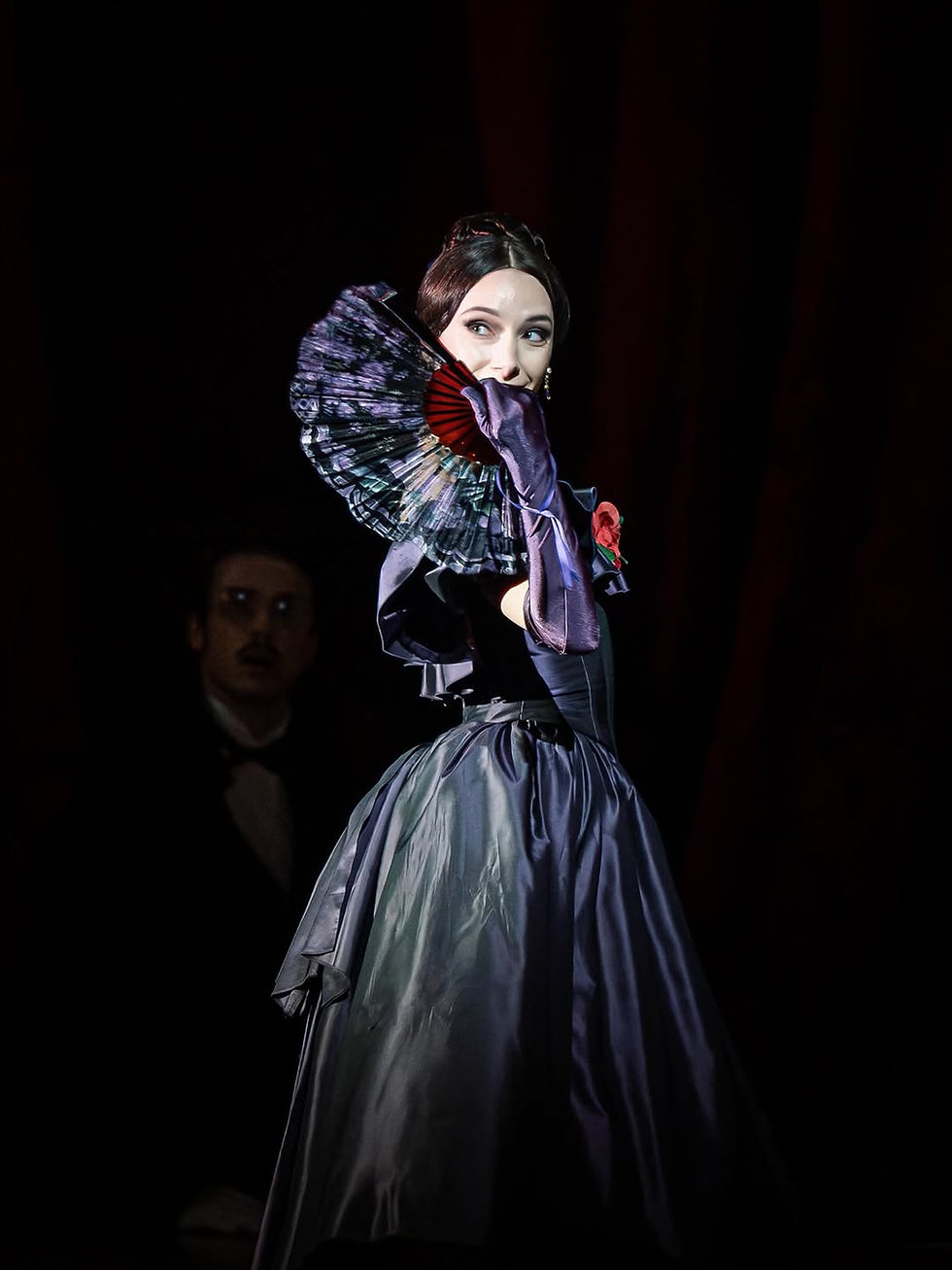
Ksenia Shevtsova in The Lady with Camellias | photo by Nicholas MacKay
Is there something in Marguerite's fate that touches you personally — not as a dancer, but simply as a woman?
KS: Her capacity for self-sacrifice, I think. I keep returning to it. Marguerite makes this enormous sacrifice — she leaves Armand. But was it worth it? In the end, her fate and Manon's were the same. What matters is whether she was honest with herself in that choice. On one hand, yes — she acted as her conscience told her, to protect Armand. On the other hand, how could she be truly honest if she turned away from her own love? Perhaps Marguerite was honest with herself, but not with her feelings. And how things should have gone, we will never know.
When you eventually step away from this role — what will stay with you from Marguerite Gautier's world?
KS: Bruises and grey hairs (laughs).
I love your sense of humour. Does that ability to laugh at yourself and your work actually help?
KS: Not everyone appreciates my humour, as it happens. And not everyone understands it.
That's all a matter of translation — and the gap between mentalities and cultural contexts.

Ksenia Shevtsova in Illusions — like Swan Lake | photo by Katja Lotter
Germany runs like a thread through your life. First, after graduating, you nearly left for Berlin to work with Vladimir Malakhov — but stayed in Moscow. Then came the fateful Munich tour when you stepped on stage mid-performance from your seat in the stalls to replace an injured dancer in Mayerling. That tour launched your career and put you on the radar of the company. And here we are again in Munich — and you are a principal dancer of the Bayerisches Staatsballett. Do you feel a particular connection to this country?
KS: I've thought about this myself. I had the chance, right after graduating from the Vaganova Academy, to come to Germany — and then that remarkable episode with the Bayerische Staatsoper.
At some point during my first season at the theatre, I remember being upset that things hadn't worked out with Germany. But now I understand it was meant to be. One way or another, my path would have led me to this theatre. Even if I had gone straight to Berlin, at some point I would have wanted to work with Igor Zelensky at the Bayerische Staatsoper, and sooner or later Laurent Hilaire would have come here too. The journey would have been different, but the destination much the same.

Ksenia Shevtsova in La Sylphide | photo by Katja Lotter
I have no regrets now, and I value everything the Stanislavsky Theatre gave me. It is my home. I was taught there, shaped into a professional there, and so many important roles happened there. In the end, everything worked out exactly as it should have.
And are you a fatalist?
KS: I'm an optimist!
But Laurent Hilaire and Germany do seem written into your destiny. You once said in an interview that moving from St. Petersburg to Moscow after graduating felt easy, because you don't attach yourself to places — that home is wherever you are. How has your adjustment to Germany been? Do you feel at home here yet?
KS: No… When you move as a schoolgirl from St. Petersburg to Moscow, you experience it differently. Your identity hasn't yet formed, you haven't earned your own living, you haven't made your own home. Moving to Germany is something else. Moscow was a real home — I was my own person there.

Laurent Hilaire — the artistic director of the Bavarian State Ballet | photo by Julian Baumann
I read that there's a turning point in emigration at around three years — when you no longer quite belong in the new place, but no longer quite belong in the old one either. The theatre is different too, and it's hard to let go of old patterns of behaviour. There's even, I think, a difference in how ballet itself is understood and experienced here. But from the beginning, this move to Germany felt like a challenge I had to face — to find out whether I was genuinely a professional, or whether I had simply been lucky to dance solo roles at some point.
I came here to gain experience and broaden my repertoire. And along the way I find moral support in my director, Laurent Hilaire — though he may not even know it (laughs). I trust his artistic judgement, his willingness to take risks, and I share his passion for everything new.
Whatever the case, you have to live in the present. It's not easy, but I try. And my home is still wherever I am.
But home is often not a place — it's people, friends, a company.
KS: Yes, I don't lose the connections. It helps enormously that Zhanna Gubanova also dances at the Bayerische Staatsoper — we were friends before, and she is part of my past, my present and my future (laughs). When I first came to Munich, Vlad Kozlov from the Bolshoi was still here. He's like a brother to me. And we do have a wonderful Russian-speaking community here. And of course there is Laurent Hilaire — my old and current director, who has played such an important role in my life. However frightening the move felt, I knew there was someone familiar here who knew me and understood how I work.
But honestly, what I miss most, in the theatre, is my coach — Margarita Drozdova. I miss her every day. I miss her guidance in preparing roles and productions. I miss her judgement. I simply miss her presence in the rehearsal room.

Margarita Drozdova with Oksana Kardash and Ksenia Shevtsova | photo: K. Zhitkova
Have you found any favourite places or rituals with colleagues — the way you had in Moscow?
KS: Well, Zhanna Gubanova and I are still going to the banya! The banya here is different, of course — it's a German sauna. Back home, a banya is as quiet as a library. Here it's a proper techno rave. Zhanna and I were laughing hysterically in the steam room at first — I thought we'd get thrown out! It's different here — just hot and fun. No purification of soul and body (laughs). But we love it. We go along and embrace this new sauna culture.

Ksenia Shevtsova, Julian MacKay and Zhanna Gubanova in The Lady with Camellias | photo by Nicholas MacKay
Ballet dancers tend to dislike being asked about their favourite role. But over the past few seasons in Munich, your repertoire has grown in many very different directions. What has surprised you, or revealed something unexpected?
KS: I can't single anything out. Even working on a familiar ballet with a new partner is always a revelation. The most extraordinary thing is working with living choreographers — like John Neumeier. Those are the moments you treasure, and you remember every word.
When we were rehearsing Le Parc with Laurent Hilaire, so much opened up. It seems like such a minimal language — everything so clear, nothing complicated. But when we started dancing, every movement was wrong. Laurent Hilaire was the original cast of that ballet — Preljocaj created the work on him. So he went through every breath with us in detail. You think: "My God, I haven't even taken a step yet and I'm already doing it wrong." But that's how it is. I watched the video afterwards and I can see the difference in the physical language: I am always Ksenia Shevtsova. But it's interesting — searching for a different physical language, working on roles with people like that.

Ksenia Shevtsova in Park | photo by Gherciu Serghei
Choreography is the stylistic philosophy of your body. It changes. Your movements change, and you change with them. That transformation is what interests me. It isn't just learning a sequence of steps — it is becoming another person.
Are there any roles you dream of?
KS: Next season we have a new production by Edward Clug — he's creating a work for our company. I've performed in his choreography before: I danced Radio & Juliet, though I didn't work with Edward directly. I really hope to be in the cast and I'm looking forward to the rehearsal process.
Then let's put that wish out into the world — may it come true. And I would love to speak with you again about that ballet. Is there anything else you dream of?
KS: I don't know — I don't really dream anymore. I'm such a realist. Though the characters I dance are all such dreamers (laughs). I don't think I ever dream. Why would you? You wish for something and it won't come true anyway if you can't make it happen yourself. Then you're left disappointed. I'm a realist.

Ksenia Shevtsova and Julian MacKay in The Lady with Camellias | photo by Nicholas MacKay
Seek to see Ksenia Shevtsova and Julian MacKay's duet on the stage of the Bayerisches Staatsballett in the new theatre season.
Journalist: Margarita Makhrina
Comments