
Maude Fealy: Yolanta Without a Voice and a Star of Two Theatrical Eras
How an American actress journeyed from a childhood operatic role and the London stage to silent cinema and Hollywood, before founding her own acting school
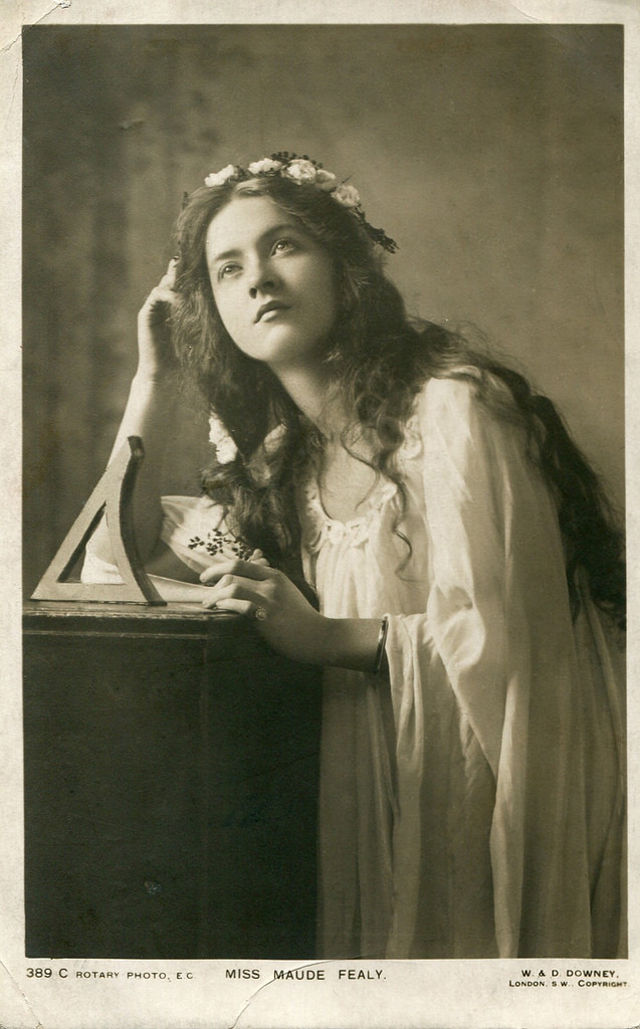
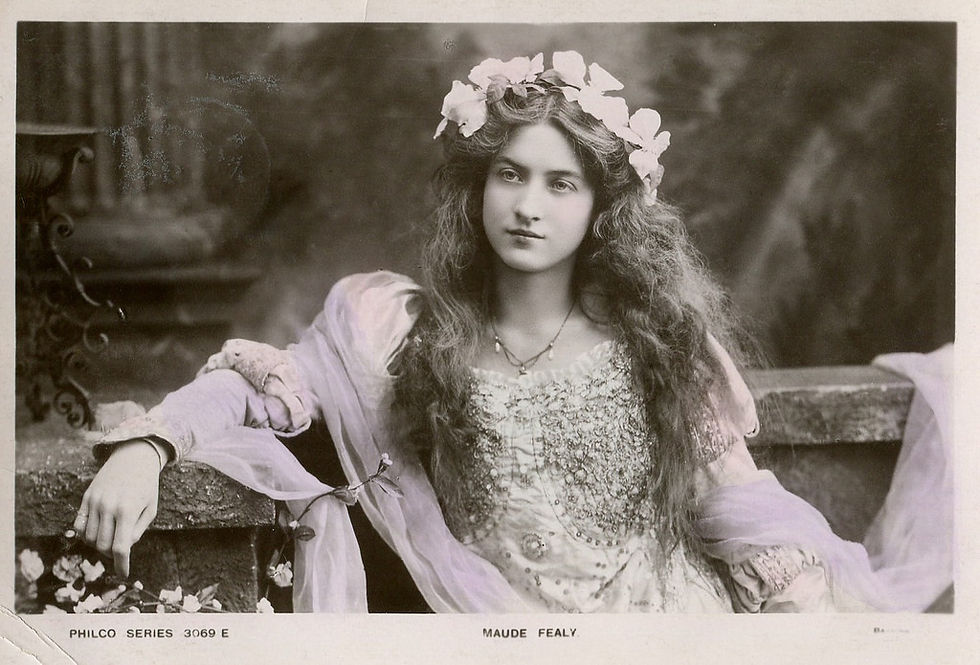
In old photographs, Maude Fealy is easy to mistake for a heroine created by the era itself: waves of light-coloured hair, a delicate profile, enormous eyes, and a gaze that seems to linger on the viewer a little longer than it should, with a dreamy, almost languid quality. In 1903, her photograph won a prize in an international beauty contest organised by the Parisian publication Figaro Illustré. Yet Fealy’s story is interesting for reasons that go far beyond the fact that her contemporaries considered her beautiful.

Behind that face lay a professional career that was unusual for its time. Fealy was a stage actress, film star, director, playwright, and teacher. She worked during an era when actors still had to prove their abilities primarily on stage, before bringing that experience to early Hollywood. For opera audiences, her name is particularly significant for one reason: in 1913, Fealy played the blind Princess Yolanta in the surviving silent film King René’s Daughter. This was not an adaptation of Tchaikovsky’s opera, but an independent version of Henrik Hertz’s play — the same literary source on which Iolanta is based.
The Stage Began at the Age of Three
Maude Fealy was born in Memphis, Tennessee. Archival sources disagree about her date of birth: the Denver Public Library gives 4 March 1881, while the Thanhouser Archives list 3 March 1881 and also note that 1883 is sometimes cited. For an actress whose career began in childhood, this uncertainty seems almost symbolic: from the outset, her biography unfolded across several parallel worlds — theatre, cinema, and public life.
Her mother, Margaret Fealy, was an actress. Her daughter grew up literally backstage and made her stage debut at the age of three, playing an angel in a production inspired by Faust and Marguerite, in which her mother played Marguerite. At five, Maude played Little Willie in The East Lynne Tragedy and Mimi in Rip Van Winkle.
Her mother, however, did not want to turn her child into a theatrical machine. Margaret placed great emphasis on her daughter’s education, teaching her herself and sending her to school. Maude would later establish a theatre school in Denver. This detail is important to understanding Fealy: she did not simply inherit a profession but gained an early appreciation of the discipline, practice, and continuous learning that acting requires.

At fifteen, Fealy played Juliet. The role brought her such success that she began receiving invitations to major productions. When producer Fred Whitney considered her too young for the role of Eunice in Quo Vadis?, Fealy did not argue about her age. Instead, she performed a scene from Romeo and Juliet and won the role through her acting.
How a Young Actress Became Alice Faulkner
Even more theatrical is the story of her meeting with William Gillette, the actor and playwright who helped shape the stage image of Sherlock Holmes. Gillette wanted to see Fealy play Alice Faulkner in his own play, Sherlock Holmes, but initially considered her too young.
Fealy arrived for her second audition prepared not only psychologically but visually. Together with her mother, she bought a long dress and high-heeled shoes, then styled her hair to make herself look older. The strategy worked: she won the role and became Gillette’s stage partner. The production toured the United States before travelling to London, where Fealy performed at the Royal Lyceum Theatre.

Her work in London opened the door to a theatrical circle that, for an American actress in the early twentieth century, was more valuable than any newspaper advertisement. Fealy worked with Henry Irving and performed roles associated with the serious British theatrical repertoire. Her parts included Rosamond in Becket, Julie in The Lyons Mail, Nora in Waterloo, and Marie in Louis XI.
Yet Fealy was not an actress confined to a single type of character. Working with E. S. Willard, she could move between different productions and master new roles in a short period. Archival materials highlight her ability to portray a wide range of characters. This versatility would become particularly important in cinema, where actors had to tell stories through gestures, silhouettes, and facial expressions.
A Beauty She Did Not Consider an Achievement
In 1903, Fealy’s photograph won a prize of one thousand francs in an international beauty contest. According to the actress herself, tens of thousands of photographs had been entered. Her reaction to the victory, however, was unexpected: she did not consider the award proof of her personal worth and did not want to accept the money, since the photograph—not her professional abilities—had been recognised.
This episode reveals much about her attitude towards public attention. Fealy understood the power of an image but did not want it to replace the work itself. In the early twentieth century, actresses were often marketed to the public primarily as faces, silhouettes, and objects of admiration. Fealy, by contrast, consistently brought the conversation back to her craft: the voice, the role, the rehearsal, and her ability to transform herself.
From Stage to Screen: Yolanta Without Music
In 1911, Fealy began appearing in films for Thanhouser, one of the prominent American film companies of the early cinema era. Her transition to film was not the debut of an unknown actress but the arrival of an already established theatrical star. In 1913–1914, the studio actively promoted her name, presenting Fealy as one of its leading stars.
Her most intriguing work for opera audiences remains the 1913 film King René’s Daughter. Directed by W. Eugene Moore Jr., the film featured Fealy as Yolanta and Harry Benham as Count Vaudémont. It consisted of three parts and was based on Henrik Hertz’s play. Its working title was Iolante.
The plot is familiar to admirers of Tchaikovsky’s opera: a blind king’s daughter lives in isolation, unaware of her blindness, until love and an encounter with the outside world transform her fate. Yet Fealy’s film offers an entirely different means of storytelling. There is no Tchaikovsky orchestra, no vocal parts, and no leitmotifs. Yolanta’s emotional state must be conveyed through her face, gestures, pace of movement, and interaction with the space around her.
This is precisely why the film matters as more than a curious early adaptation. It allows us to see how the same dramatic material can exist in two different art forms. In opera, Yolanta’s inner awakening unfolds through the voice and the musical line. In silent cinema, it must emerge through the actress’s very presence: the way she looks, touches objects, responds to other people, and gradually changes her physical behaviour.
The film survives, with copies held in the Library of Congress archives and the Blackhawk Films collection. This is particularly valuable for the history of early cinema. Many films from the silent era have been lost, so the opportunity to see Fealy in one of her principal roles transforms King René’s Daughter from an archival footnote into a living subject for comparison.
Fealy as Creator and Founder of Her Own Theatre Company
Working in film did not mark a permanent change of profession for the actress. In 1912 and 1913, Fealy and her husband, James Durkin, established their own company, Fealy-Durkin. They performed in Denver at the Casino Theatre in Lakeside Amusement Park. Fealy later continued acting on stage, directing productions, and writing plays.
Her original works included plays, lectures, and solo programmes. In 1917, she created Shadow Lights, and in 1928, she co-wrote The Red Cap with Grant Stewart. The play was presented at the National Theatre in Chicago.
Fealy was not content to remain a performer waiting for a producer to offer her a role. She developed her own projects, assembled casts, wrote material, and made production decisions. In modern terms, she was not only an artist but also an independent theatre producer.
Her Friendship with DeMille and a Second Life in Hollywood
In 1905, Fealy met Cecil B. DeMille in Denver. Their relationship began in the theatre and continued into cinema. For many years, Fealy helped DeMille work with actors, and she later appeared in several of his films, including The Ten Commandments (1956).
To DeMille, she was more than an actress he had known early in his career. Fealy worked as a dramatic coach at Paramount Studios, helping performers develop their stage presence and expressiveness within the demands of film production. Her experience in silent cinema, theatre, and teaching became particularly valuable as Hollywood transitioned to sound films and had to relearn how to work with the voice, pauses, and spoken dialogue.
Fealy later opened acting schools and studios of her own. The Thanhouser Archives name Edwina Booth and Nanette Fabray among her students. She taught not only performance technique but also an approach to the profession that she had inherited from her mother: an actor must be prepared, educated, and capable of continuing to work even as fashions change.
Her Final Role
In 1963, at approximately eighty years of age, Fealy played the leading role in Denver in her own play about Emily Griffith, a prominent educator and founder of educational initiatives. This performance became her final stage appearance.
Fealy died on 9 November 1971 in Woodland Hills, California. She spent the last two years of her life at the Motion Picture Country Home and Hospital, a facility for members of the film industry. She was buried at Hollywood Memorial Park Cemetery. According to the Denver Public Library, her place in the mausoleum was a bequest from Cecil B. DeMille.

A Face That Remained in History
Maude Fealy is easy to remember from her photographs. But the photographs are merely the entry point to her story. Behind them, we discover an actress who began working as a small child, played Juliet in her youth, found herself in London alongside leading figures of the British stage, and later became one of the notable performers of early American cinema.
Her portrayal of Yolanta is particularly significant for the world of opera: Fealy played a heroine whose inner life is usually revealed through music. She did so in an art form stripped of voice, orchestra, and live sound. In this way, the actress left a rare testament to the fact that the dramatic power of a character can survive even when its familiar means of expression disappear.
Fealy spent almost the entire twentieth century pursuing her profession. She never remained confined to a single role, nor did she allow early fame to become the end of her story. Hers was a life of constant transition: from stage to screen, from performance to authorship, and from acting to teaching. That is why Maude Fealy deserves to be remembered not merely as a beautiful woman in old portraits, but as an artist who continually found new ways to make the stage her own.
Her portrayal of Yolanta is particularly significant for the world of opera: Fealy brought to life a heroine whose inner world is usually revealed through music. She did so in an art form without voice, orchestra, or live sound. In doing so, she left behind a rare testament to the ability of a character’s dramatic power to endure even when its familiar means of expression have disappeared.
Fealy devoted almost her entire life to her craft. She never confined herself to a single role, nor did she allow her early fame to become the final chapter of her story. Hers was a life of constant transformation: from stage to screen, from performer to creator, from acting to teaching. That is why Maude Fealy deserves to be remembered not merely as a beautiful woman in vintage portraits, but as an artist who continually found new ways to make the stage her own.
Comments