
One Theatre, Two Perspectives: Tamas Solymosi and Marmus Auguste on the Competition, the Bronze Medal, and an Artist’s Future
Updated: Jul 8
After the XV International Ballet Competition came to an end, Marmus Auguste’s bronze medal became an important event not only for the artist himself, but also for the Hungarian National Ballet, which he represents. The young dancer went through several rounds, demanding programs, and growing competitive pressure while preserving what matters most: stage expressiveness, technical focus, and the ability to remain fully inside the character.
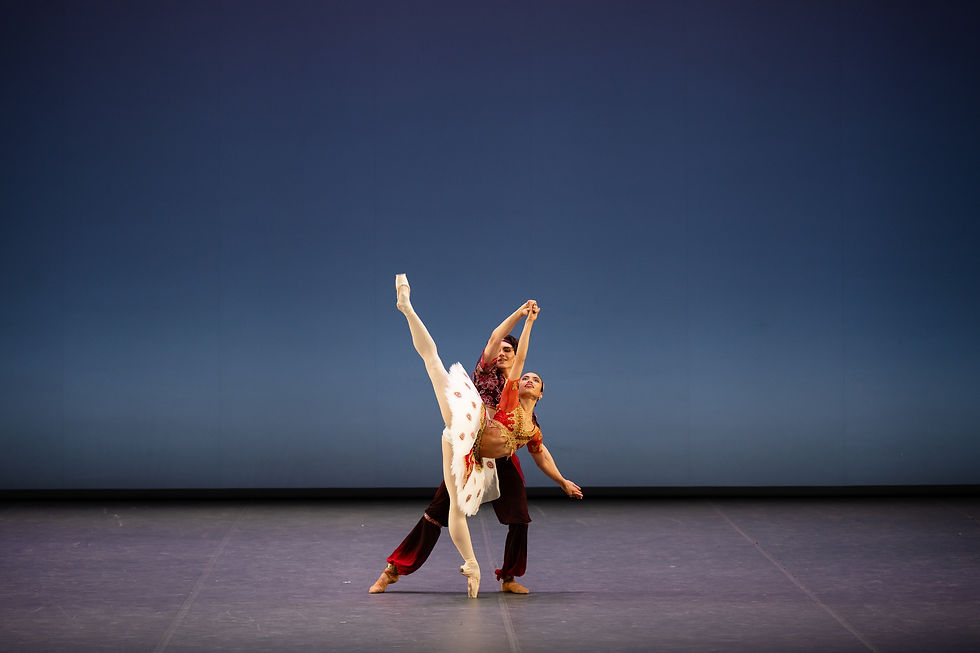
We spoke with Tamas Solymosi, Director of the Hungarian National Ballet and People’s Artist of Hungary, about what makes him proud of his artist and why the Moscow competition remains one of the most important platforms for young dancers. And then we spoke with Marmus Auguste after the competition about how his perception of himself as an artist has changed, what mattered most in the third round, and why the repertoire he chose reflects his artistic nature so precisely.

First of all, congratulations to you and Marmus Auguste on the bronze medal. As his director and mentor, what are you most proud of in his performance at this competition?
I am always happy to see my artists on stage. And I am especially happy when I see such ambition as Auguste has. He is a wonderful young man, very determined, and what he does on stage draws the eye.
As his director, I am very proud to have the opportunity to work with him. He is a wonderful colleague and a fantastic artist. I think we will hear a lot more about him in the future.
As a jury member, what qualities did you especially notice in this year’s participants?
I always say that the Moscow International Ballet Competition is one of the best competitions in the world, truly the highest professional level. Here you can see talented dancers, work alongside wonderful jury members, and observe how the entire competition is organized.
It is also very important how much care is given here to the artists, the jury, and the audience. It is a unique atmosphere. I hope we will return for future competitions, because for any artist’s career it is very important to come here, step onto this stage, and present oneself.
You lead the Hungarian National Ballet and work extensively with young artists. What are you looking for in the new generation of dancers entering the profession?
For me, artistry is very important: how a dancer enters the stage, how they can tell a story, how they present different characters. Of course, technique is also important. In 2026, an artist must have technique, artistry, stamina — all of it together. When all these qualities come together, then something unforgettable can be created.
How do you see the role of international competitions such as the International Ballet Competition in shaping young careers?
It is very important. If a young artist has the opportunity to come here and compete at such a high level, it becomes a significant part of their professional path. I am sure that in the future we will see these artists in leading companies, and we will see them as colleagues.
I hope that some of these dancers will one day work in my company as well. I wish them all the very best. I think we can all be happy to see these young artists on stage.
Is it a secret who you have already noticed for your company?
Of course, it is always a secret. But when I watch a competition, it is truly important for me to imagine how a particular artist might look in my company.
In Budapest, about 90 percent of the repertoire is classical ballet. We treat the classical repertoire, as well as the artistic and technical level, with great care. The competition is a wonderful opportunity to see such artists. I hope that in the future I will work with the best dancers I was able to see here.

Auguste, has your perception of yourself as an artist changed after the first rounds?
Yes, definitely. After the first rounds, I became much more aware of how important it is to pace myself as a dancer. At the beginning there is a lot of emotion and excitement, and in the first round you naturally give a lot of energy. But as the competition goes on, especially in the second and third rounds, you start to understand how important it is to manage that energy over time, because the programs become longer and more difficult, and the level continues to rise.
For me, it became not only a question of performing, but also of pacing, control, and the ability to remain consistent and strong throughout the whole competition.
What was the most important thing for you in the third-round program?
For me, the most important thing was to enjoy the stage as much as possible. Of course, there is a huge responsibility, especially when you are dancing on a stage with such history and tradition as the Bolshoi Theatre. It is a very special feeling.
I try to remind myself not only of the pressure, but also of what a privilege it is to be there. In the third round, I wanted to stay focused, but at the same time enjoy every moment and truly connect with the stage, the music, and the audience.
What does the repertoire you chose say about you as an artist?
The repertoire we chose was mainly about finding roles that truly suit us as artists. I like to be very expressive and fully immersed in the character I am dancing.
All the pas de deux we selected are quite different in character, but each of them gives a lot of space for acting and interpretation. At the same time, they allow me to show strong technique: triple saut de basque in Pas d’esclaves, several double tours en l’air in Harlequinade, as well as more complex lifts and turns in the adagios.
I would say this repertoire reflects my desire to combine both sides: strong technique and clear expressiveness, so that the audience can truly enjoy the performance and feel connected to it.
If you could say something to yourself before the first round, what would it be?
I would say: just do your best and trust all the preparation and rehearsals you have had. The first time on stage at a competition like this always comes with new sensations: the floor, the theatre, the atmosphere — everything can feel different.
But in the end, you are ready. Trust that, stay calm, and allow everything to happen naturally. Just enjoy it.
Marmus Auguste’s performance in the third round was especially revealing: by that point, the competition demanded not only technical precision from the participants, but also great inner stamina. After several rounds, rehearsals, and constant pressure, artists inevitably approach the final stage of the competition with accumulated fatigue. It is precisely at this moment that one can clearly see who is able to preserve composure and artistic focus on stage.
In the third round, Marmus Auguste and Rachel Pimentel Quintao performed the pas de deux from Spartacus, one of the most demanding and dramatically intense works in Yuri Grigorovich’s choreography. This piece requires not only physical strength and technical confidence, but also a precise understanding of style, scale of gesture, and the inner tension of the characters. Despite the high level of competitive pressure, the artists met this challenge with dignity: their performance demonstrated maturity, stage concentration, and the ability to work with material that demands complete commitment from the performer.
Interviewed by Nina Teseyko
Credits: the press service of the contest, Stanislav Ivanov, Anna Russkikh, Tina Berezhnaya
Comments