
“Pelléas et Mélisande” at the Staatsoper Berlin: Water, Mystery and Voices of the Old School

Claude Debussy’s Pelléas et Mélisande, directed by Ruth Berghaus, has returned once again to the Staatsoper Unter den Linden. This production has been part of the theatre’s repertoire since 1991, and that fact alone gives the evening a special aura: what appears on stage is not merely another revival, but an encounter with the theatre’s history, with a particular aesthetic, and with the artists through whom many of us once discovered opera.
For me, the evening was also deeply personal. The production brought together singers from that very "old school" – artists with whom, around 15 years ago, my own journey into opera began. It was both astonishing and moving to see Anne Sofie von Otter, Magdalena Kožená and Simon Keenlyside on stage again. Alongside them was Thomas Blondelle as Pelléas, already well known to Berlin audiences for his interpretation of the role at the Komische Oper Berlin.

Pelléas et Mélisande is Debussy’s only completed opera and is often described as an "opera without arias." There is no conventional progression from one number to the next: one musical moment flows into another, like water – one of the central images, and almost an independent character, in this work. The fountain, the well, the pond, the sea, tears, hair flowing like living matter — everything in this opera is connected with fluidity, instability, and the impossibility of fully grasping reality.
That is precisely why I feel especially close to a minimalist approach to this opera – such as the one Robert Wilson once offered. Pelléas does not need excessive realism. This story is filled with mystery: we do not know the exact time or place of the action, nor the origins of the main characters, especially Mélisande. Throughout the opera, her otherness is constantly emphasized: she seems not entirely human, but rather a being from another world – a fairy, a nymph, a vision that has accidentally found itself among people.
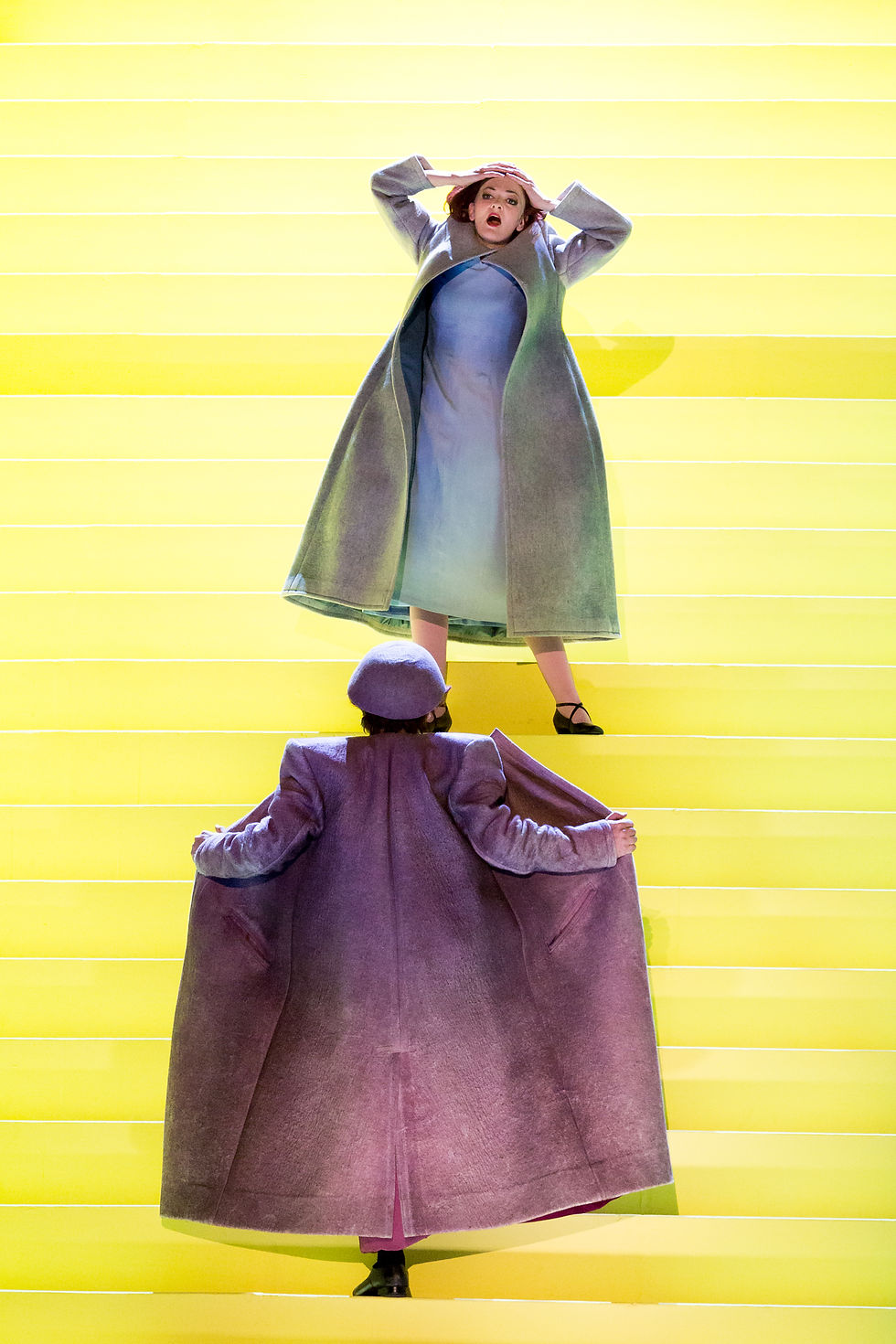
Berghaus’s production is quite minimalist, yet at the same time highly practical in theatrical terms. The space transforms almost magically: the same stage mechanism becomes, in turn, a castle, a tower, Mélisande’s room, a garden, a well or a pond.
The greatest strength of the production lies in its performers. It is a rare case when one wants to thank literally every singer: each of them did not merely perform Debussy formally, but filled the music with human breath, emotional nuance and inner drama.
Magdalena Kožená created a Mélisande who was both fragile and independent. At times, an almost childlike intonation appeared in her voice – not childishness, but rather the vulnerability of a being who does not fully belong to this world. Yet alongside this fragility, there was also strength: her Mélisande was not simply a passive victim of circumstance; she retained her mystery and her own will.

Simon Keenlyside was remarkable as Golaud. His voice sounded by turns tender, angry, and almost comical in the scenes of jealousy. Especially powerful was the episode with Yniold, when Golaud tries – through both tenderness and pressure – to force the child to reveal something about Mélisande and Pelléas, exposing a painful human weakness that is almost ridiculous in its helplessness.
Thomas Blondelle, as Pelléas, revealed himself especially in the scene of the declaration of love. Until that moment, his character had seemed emotionally detached, closed off, almost inaccessible. But when the confession finally came, the feelings burst out with such expressiveness that the scene became one of the most vivid and intense moments of the performance.
At the same time, I still feel an inner resistance to those moments in which the opera is translated too directly into the realm of everyday realism and physical violence. I do not feel close to interpretations in which the relationship between Golaud and Mélisande is shown through overt brutality – attempted assault, beatings, especially when Mélisande is pregnant. Of course, this story contains jealousy, fear, possessiveness and destruction. But Pelléas et Mélisande exists according to a different logic. It is a simple human story told about people who are not quite of this world. Mélisande’s death – a death caused by an earthly child, by her collision with the human world – seems to me to require not a domestic, but an almost mythological interpretation.

A separate regret concerns the tower scene and Mélisande’s hair. In this opera, hair plays an essential role: Pelléas speaks of it as a living being that surrounds him with love, with light, caressing the very depths of his heart. But in this production, Mélisande has no long hair. At certain moments she appears almost without a wig, and there is a certain kind of humour in this which, I admit, remained somewhat inaccessible to me. Yes, in my favourite Robert Wilson production there is no long hair either, but there its absence is compensated for by light, scenography and a particular visual language. Here, in my view, this important symbol felt too weakened.
And yet the evening turned out to be surprisingly alive. Pelléas et Mélisande is often called a long, monotonous, almost empty opera. But it was precisely the singers and the conductor who made it emotional, tense and profoundly human.

Although I have seen this opera many times and love it dearly, I was once again interested in following what would happen next: how this particular production would reveal the characters, where it would preserve the mystery, and where it would bring them closer to us.
Perhaps this is exactly the power of Pelléas et Mélisande: no matter how many times one sees this opera, it remains unresolved to the very end.

Text: Julia Pneva
Photo: Tatjana Dachsel, Staatsoper Unter den Linden
Comments