
Blood, Passion and a Starry Sky: Samson et Dalila in Berlin
Updated: Jul 12
On July 4, Staatsoper Unter den Linden in Berlin presented the premiere of a new production of Camille Saint-Saëns’s opera Samson et Dalila — a work that had already been part of the theatre’s repertoire. The leading roles were performed by Roberto Alagna and Aigul Akhmetshina, for whom the role of Dalila marked her debut on the stage of Staatsoper Unter den Linden.
It should be said at once how gratifying it was that the director’s concept remained within the classical tradition — without shifting the time period, without forced modernization, and without adding strange new plotlines to the relationships between the characters. Today, such fidelity to the material is becoming increasingly rare, and precisely for that reason it feels especially valuable.

The production turned out to be genuinely beautiful. The very first stage image — a starry sky opening before the audience — drew a sigh of admiration from the hall. Then, in the finest traditions of opera theatre, both an animal and the ancient chariots of the Philistines appeared onstage. At the same time, the performance never felt static: the scenography remained mobile and expressive. Between the first and second acts, the stage seemed to open up anew, transporting the audience into an entirely different visual space.
And, of course, one of the most striking visual moments of the production was the final scene with Samson. I would rather not reveal all the details — this is a performance best seen with one’s own eyes.
The vocal cast was no less impressive.
For Aigul Akhmetshina, Dalila marked her debut at Staatsoper Unter den Linden. Moreover, the role itself entered her repertoire only very recently: she sang it for the first time just a few weeks ago in London. All the more remarkable, then, was the impression that the part had already been deeply absorbed and lived through by the artist.
Akhmetshina demonstrated extraordinary vocal mastery — both in the dramatic scenes, especially in the finale of the second act with Samson, and in the softer, more melodic, almost romantic episodes, among which, of course, the aria “Mon cœur s’ouvre à ta voix” occupies a central place.
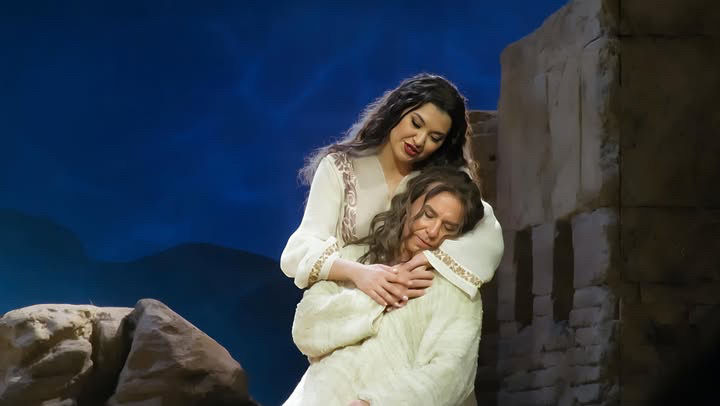
It is worth noting separately just how demanding this aria scene was from a staging perspective. The artist began singing it lying on the floor — literally fully lying down. Roberto Alagna, as Samson, then approached her and helped her rise, after which Dalila remained for some time in a half-bent position while continuing to sing. And at the most crucial moment, one that requires maximum breath control and preparation for a long vocal line, the director’s decision had Samson lift Dalila up from the floor.
Despite all these physical challenges, the scene was performed superbly. The vocal line lost none of its beauty, stability, or inner tension.
At the same time, one cannot help but mention the theatrical risk involved in what was happening onstage. There was live fire present, while the singer’s costume was long, with a hem trailing across the floor.
Fortunately, everything passed without incident, but from a safety perspective, the decision seemed rather bold — even risky.

Roberto Alagna also made an exceptionally strong impression. Known for his impeccable command of the French and Italian repertoire, he once again proved that he remains an artist of outstanding class. First, he looks magnificent onstage; second, he sings magnificently.
His Samson sounded piercing, concentrated, and focused. His voice carried clarity, dramatic power, and secure high notes. Particularly convincing were the scenes of prayerful appeal to God, as well as those in which his love for Dalila becomes at once passion, weakness, and fatal dependence.

Moreover, Akhmetshina and Alagna created a rare stage chemistry — passion, tension, drama, and the feeling of a real emotional duel. The second-act scene, to which one feels compelled to return again and again, seemed to strike virtually everyone in the hall.
In an interview with Aigul Akhmetshina, soon to be published in our magazine, the singer mentioned that this production turned out to be rather bloody and brutal. But speaking of Berlin’s theatre scene, one must admit: Berlin has seen far bloodier productions — and quite often, that bloodiness has existed more for external effect than for meaning.

Here, however, the brutality feels not only justified, but embedded in the very nature of the plot. Samson et Dalila is not about an abstract mythological conflict: the place of action is explicitly identified as Gaza in Palestine, while the musical and dramatic fabric of the opera is built around the confrontation between the Hebrews and the Philistines, the people of Israel and the world of the pagan cult of Dagon.
This is why it is especially striking to realize that already in the nineteenth century, when Saint-Saëns created this opera, this ancient story was perceived as a narrative about the conflict of land, faith, power, and identity. Today, when the geography of these names once again resonates with painful relevance, the production inevitably acquires an additional nerve. But in this case, its brutality does not appear imposed or artificial: the clash of peoples, religions, and ideas about the right to land in the ancient world could hardly have been bloodless.
In short, this is a remarkable production — beautiful, spectacular, vocally strong, and at the same time surprisingly coherent in its directorial statement.
It is all the more regrettable that in Berlin the performance with this cast will be shown only four times. In September, Samson et Dalila will return to Staatsoper Unter den Linden, but with different performers. Therefore, while there is still a chance to hear this particular cast, it is worth hurrying.

Text Julia Pneva
Photo Staatsoper Berlin, Matthias Baus
Comments