
The Return of Medea to Epidaurus: 65 Years Later
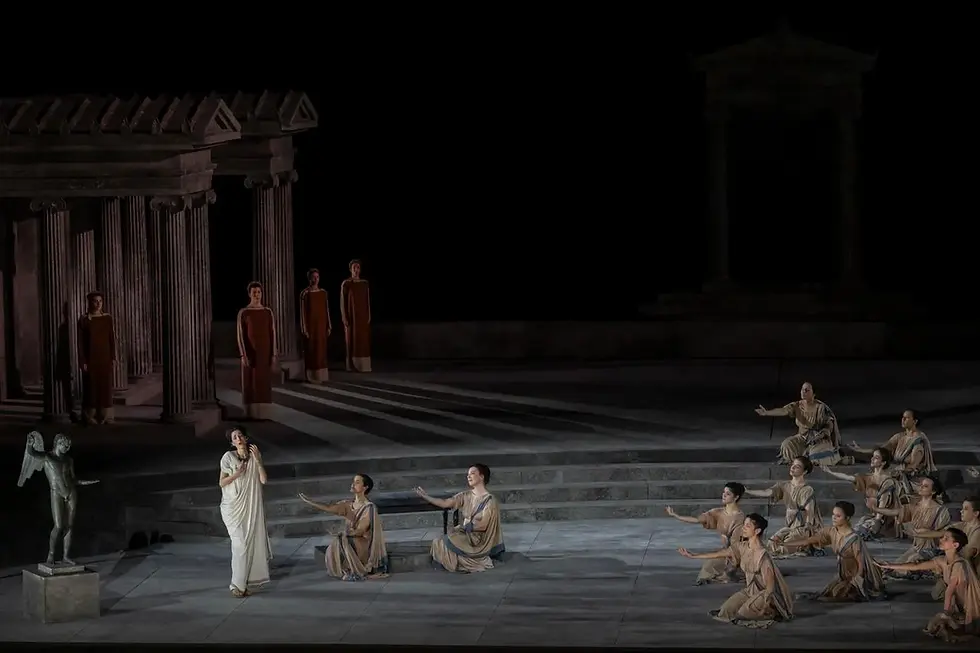
On June 20, 2026, the ancient theatre of Epidaurus once again became a place of operatic history. On the opening day of the Athens Epidaurus Festival, ten thousand spectators gathered under the open sky to witness the return of Luigi Cherubini’s Medea — the production that, 65 years earlier, had turned opera in Greece into an event of global importance. It was here, in 1961, that Maria Callas created one of her legendary stage heroines in Alexis Minotis’s production, with sets and costumes by Yannis Tsarouchis and choreography by Maria Hors.
The Opera Callas Brought Back from Oblivion
Luigi Cherubini’s Medea was written in 1797 and almost immediately found itself on the border between recognition and oblivion. Its premiere was met with restraint: audiences and critics did not immediately recognize in this score the future legendary tragedy of the operatic stage.
For many decades, Medea disappeared from the living repertoire. Its fate was changed by Maria Callas, who first performed the title role in 1953 at the Maggio Musicale Fiorentino festival. Callas transformed Medea into one of her central roles and showed the world that Cherubini’s music concealed not a museum rarity, but a burning human drama.
The role of Medea was ideally suited to her voice, temperament, and stage nature. It demands not only stable vocal technique, but also the ability to sing on the edge: between love, rage, humiliation, and the abyss. In Callas’s interpretation, Medea ceased to be a mythological monster: she became a woman from whom everything had been taken, except for the final, terrible right — to be heard and avenged.

Dallas, London, Epidaurus, La Scala: The Triumphal Route of the Production
When, in 1958, the newly founded Dallas Opera invited Maria Callas to perform in a new production of Medea, the singer made an unexpected condition: the production had to be staged by Alexis Minotis. At the time, he was known above all as an actor and director of ancient tragedies. At first, Minotis refused, as he had never worked in opera before, but eventually he agreed and invited the Greek painter Yannis Tsarouchis to design the sets and costumes.
The Dallas premiere became an absolute triumph. Critics wrote about Callas’s almost supernatural yet deeply human heroine, about the new energy of Minotis’s direction, and about Tsarouchis’s 130 unique costumes, created in Greece. Thus, a production was born in which Cherubini’s opera unexpectedly acquired the qualities of ancient tragedy: severe, monumental, and at the same time extraordinarily dramatic.
The triumphal journey of the production began in Dallas in 1958, continued in 1959 at the Royal Opera House, Covent Garden, in London, reached its historical culmination in 1961 at the ancient theatre of Epidaurus, and ended in 1962 at La Scala in Milan.
Epidaurus became the peak of this journey not only because the production found itself in one of the most famous ancient theatres in the world, but also because it was here that Minotis’s vision was revealed in full. In Dallas and London, Medea existed within the space of the opera stage — with the familiar theatrical footlights, wings, sets, and enclosed auditorium. In Epidaurus, everything was different: the open sky, the stone rows of the amphitheatre, the vast distance between stage and audience, and the very memory of the place demanded a different scale.
Minotis understood that in such a space it was impossible to play an intimate psychological drama in the usual sense. Gesture, movement, pause, the appearance of the chorus, and the very figure of Medea had to become larger, stricter, almost more ritualistic. He therefore reconsidered his directorial approach: the production had not merely to tell the story of a betrayed woman, but to return the viewer to the ancient nature of myth — to a world where personal pain becomes fate, and a human act acquires an almost cosmic scale.

Tsarouchis adapted the sets and created new costumes for approximately 250 participants in the production.
At that moment, Medea ceased to be merely an opera production: it became a meeting point of myth, music, and Callas’s personal destiny. She arrived in Epidaurus already at the side of Aristotle Onassis — the man who became for her love, liberation, and a future wound. Their romance began like a dazzling Greek fairytale: the yacht Christina, the Mediterranean Sea, a world of luxury and absolute freedom. But gradually, that fairytale turned into a drama of dependence, waiting, and betrayal.
That is why her Medea in Epidaurus sounded not like a distant ancient figure, but like an almost prophetic role. Callas sang a woman abandoned by the man for whom she had crossed the threshold of her former life. She did not yet know that, a few years later, Onassis would deal her his own blow by choosing Jacqueline Kennedy. But already then, in her Medea, one could hear what would make this role legendary: not theatrical revenge, but the pain of a woman who loved too deeply and found herself facing emptiness.
Memories of Callas in this production always sound almost mythological. For her partners and designers, she was not simply the performer of the title role, but a co-creator of the image. Yannis Tsarouchis, who designed the costumes and sets, called Callas an artist of remarkable intuition and theatrical instinct after discussing Medea’s image with her. She herself proposed important details of the costume — in particular, a cloak that would strengthen Medea’s silhouette — and together with Tsarouchis discussed her three costumes. Letters and archival materials also mention that Callas liked the idea of the final chariot and an almost ancient deus ex machina: the heroine’s appearance above the human world, no longer as a woman, but as a terrifying force of nemesis.

Outwardly, her Medea was far from a decorative "ancient queen." It was a severe, almost sculptural image. The long cloak, the sharp lines of the costume, the majestic posture, and the stillness made Callas resemble a living statue carved from darkness and pain. In the vast space of Epidaurus, every detail had to be legible from afar: not small facial expressions, but silhouette; not everyday gesture, but sign; not merely a costume, but a continuation of the heroine’s inner state.

Reconstruction Without a Video Recording
To revive this production in 2026 meant not simply to repeat a famous performance, but to assemble it anew — from traces, fragments, and memory. The work took several years: the team of the Greek National Opera studied archival materials, photographs, sketches, Alexis Minotis’s directorial notes, documents from the Historical Archive of the GNO, the Cultural Foundation of the National Bank of Greece, and private collections. The main difficulty was that no full video recording of the 1961 Epidaurus Medea exists.
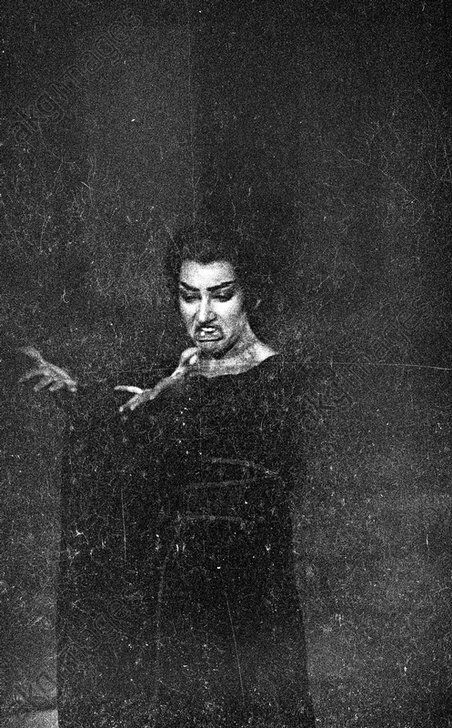
"We have only photographs of that production, and they are black and white," explained GNO Artistic Director Giorgos Koumendakis. These images helped restore the scenography, but they could convey neither the colors, nor the textures, nor the movement of the performance. The reconstruction therefore became not a literal copy, but an attempt to restore the spirit of the original: to understand how the production looked, how it moved, how it breathed in the space of Epidaurus.

Lily Pezanou worked on the sets. Drawing on surviving photographs, models, and archival materials, she recreated Yannis Tsarouchis’s scenography anew. It was important not simply to repeat the outlines of the earlier sets, but to restore the organic quality that had made them seem like part of the ancient theatre itself. In the 2026 version, the stage was not meant to "stand" inside Epidaurus like a foreign construction, but to appear as though it had grown out of its stone, light, and space.

The situation with the costumes was different: around 150 original costumes by Tsarouchis have survived. Costume designer Tota Pritsa studied them as museum artifacts — the fabrics, cuts, textures, dyeing methods, and sewing techniques. But the task was not only restoration. The production required costumes in which modern performers could move, sing, and exist on stage. Pritsa therefore created exact replicas, selecting rare fabrics and restoring Tsarouchis’s color palette. As the GNO emphasized, these costumes were meant to come close to the sculptural quality of ancient Greek clothing.

The work with fabrics proved especially complex. Some of the materials used in 1961 are now almost impossible to find, or are no longer produced at all. The fabric therefore had to be not only selected, but also artificially "aged": washed, treated, and brought to the necessary softness, depth of color, and patina of time. In daylight — and in Epidaurus this is especially important — the color range of the costumes revealed itself differently than in the evening, and this also had to be taken into account.
The directorial reconstruction posed a separate challenge. Panayis Pagoulatos could rely on photographs of rehearsals and performances, as well as on notes in Minotis’s notebooks, but no complete picture existed. Information survived about the choral scenes, mass formations, and choreography, but not about all the details of the work with the soloists. Pagoulatos therefore built the production anew, not trying mechanically to reproduce every movement from 1961, but creating a coherent staging faithful to the spirit of the original.

Maria Hors’s choreography was also revived not as an archival quotation, but as a restoration of a style of movement. Gianna Philippopoulou and Kelly Zambela studied Minotis’s notes and the surviving materials in order to return to the production its distinctive physical language: severe, ritualistic, connected to the chorus and to the very breathing of the ancient stage. The lighting design by Christos Tsiogkas, in turn, was created in dialogue with Tsarouchis’s visual language.
Thus the new Medea became not the restoration of a museum exhibit, but a living conversation with the past.

Anna Pirozzi: Not to Copy, but to Inhabit
A few days before the performance, Italian soprano Anna Pirozzi, who sang the role of Medea, said in an interview: "I do not want to copy, I do not want to imitate Maria Callas. I love the way she interprets the role. I took several gestures that she used in 1961 because I find them very dramatic. But overall, I try to make the role my own."
"This role is very difficult, also because it has to be acted," she explained after the performance. "It is not enough simply to sing. You have to interpret. You have to inhabit this sorceress-woman and the terrible murder she commits at the end, somehow truly understand her. It is very difficult — especially here, in this theatre, where Maria Callas performed the role so magnificently."

Sources: Athens Epidaurus Festival, Euronews, Seen and Heard International, Daily Sabah, Neos Kosmos, The Athens Official Guide, el culture, Wikipedia / Médée (Cherubini).
Comments