
A Cherry Tree, but Not in Bloom

The Cherry Orchard. The Orchard of Cherries is a new production born on the stage of the Stanislavsky and Nemirovich-Danchenko Moscow Music Theatre. The driving force behind the project was People’s Artist of Russia and Mariinsky Theatre prima ballerina Diana Vishneva, while the production itself was made possible with the support of the Diana Vishneva Foundation for the Development of Ballet Art. Alexander Tchaikovsky composed the music for this choreographic adaptation of Chekhov’s play of the same name, with Pavel Glukhov and Maxim Sevagin creating the ballet’s text. Despite the strong desire to get straight to the point — to see the stage and share the excitement of the premiere with the performers and creators—the background and context must nevertheless come first.

A two-act ballet based on A.P. Chekhov’s The Cherry Orchard can be regarded as another example of the choreographic tradition of recent years: turning to the inexhaustible (which, in fact, is precisely what needed to be demonstrated) source of meaning and inspiration that is classical literature. Chekhov’s works, alongside the timeless texts of Dostoevsky and Tolstoy, have served and continue to serve as a rich foundation for various forms of artistic expression, in this case dance. One need only recall the well-known production of Chekhov’s Anna on the Neck, set to music by Valery Gavrilin and choreographed by Vladimir Vasiliev. And so, the play about the twists of fate in the life of one family, and more broadly about the situation in the country at the turn of the century — the fading aristocratic era and the approaching global changes—has joined the ranks of literary works interpreted through ballet.

The new production could have been yet another reading of a classic (although, by and large, that is exactly what it is) were it not for one key feature. The title, constructed as a verbal palindrome, is no coincidence: the concept of the performance is built around a contrast, with the first part, The Cherry Orchard, presenting one version of events, and the second, The Orchard of Cherries, offering its opposite.
The more "textbook" interpretation was undertaken by Pavel Glukhov, a Golden Mask Award laureate and creator of the recent productions The Lower Depths and The Nutcracker: A Fairy Tale Untold. The more fantastical second part was entrusted to Maxim Sevagin, artistic director of the Stanislavsky and Nemirovich-Danchenko Moscow Music Theatre and a graduate of the Vaganova Academy.
Judging by the verbal descriptions of the concept, Glukhov’s "piece" is something of a retelling of Chekhov’s plot, sequential and detailed, as evidenced by the comprehensive scene-by-scene libretto accompanied by original quotations. The second half, Sevagin’s creation, features the same characters and the same story, but seemingly stripped bare, revealing what had remained offstage in the previous act. What are the characters like when left alone with themselves, cleansed of everyday bustle, conversations and merriment? How do they exist in space? What do they think about, and who are they really?
In keeping with both interpretations, the cherry orchard itself takes on different meanings: in the first, it belongs to another world; in the second, it is part of this one.
And then there is the music. The score for the first act was written from scratch by composer Alexander Tchaikovsky, People’s Artist of Russia and professor at the Moscow Tchaikovsky Conservatory, under Glukhov’s attentive — and precise — guidance. The choreographer specified the desired musical moods, accents, timing and other details.

Work on the second act was made somewhat easier by the availability of Tchaikovsky’s Sixth Symphony and a waltz he had composed long ago for the ballet Battleship Potemkin. Both compositions appealed to Sevagin’s choreographic sensibilities.
Incidentally, this was not the composer’s first encounter with Chekhov’s dramaturgy: more than three decades ago, he wrote the opera Three Sisters on commission from the Perm Theatre.
Finally, let us turn to the result.
Today, Natalia Somova, the Mariinsky Theatre prima ballerina, performs the role of Lyubov Ranevskaya, offering her own interpretation of the landowner. It is worth bearing in mind, however (whether this matters or not), that the role was created specifically for Diana Vishneva, with a hint at the conclusion of her classical ballet career.

Like a proper overture, the performance immediately establishes its mood: "anxious" notes quite literally immerse the audience in a state of gentle agitation and anticipation. This feeling is reinforced by the minimalist, restrained sets designed by Vladimir Arefiev.
A grey, cold marble-like diagonal wall, creating a sense of direct perspective, covers almost the entire stage. Arched openings and portals conceal another world behind them. A wardrobe that later comes to life, two tables — one of them a billiard table — and a piano positioned on the right complete the dimly lit setting.
Throughout the performance, shadows resembling large tree leaves play in one of the openings, the one closest to the audience and therefore the largest. This is the only evidence of the cherry orchard’s presence in the characters’ lives. The action indeed unfolds in stages, following the original plot, with the exception of the creators’ additions — for example, a prologue featuring Lopakhin’s prophetic dream.
The bustle before and during Lyubov Andreyevna’s arrival is conveyed through energetic, deliberately emotional dances. Together with the caricatured poses, they express the general excitement.
The subsequent action revolves around the triangle of Ranevskaya, Gaev and Lopakhin, with the emphasis falling more on the latter than on the heroine herself.
Lopakhin, performed by Evgeny Zhukov, appears before the audience in a grey waistcoat, trousers and yellow shoes, dressed by costume designer Svetlana Tegin. He comes across as a decisive, proactive "helper," but also as calculating and pragmatic.
His movements are expressive, perhaps even more so than the playwright intended: broad, sweeping gestures that can only be interrupted by an absurd situation. Searching for an excuse to speak to Ranevskaya, the merchant helps himself to cherries from a jar, only to find his hand stuck. The embarrassing incident takes place in full view of everyone.

The imposing Gaev, performed by Denis Dmitriev, wears a burgundy suit with a waistcoat and bow tie. He is childish, dreamy, carefree and enthusiastic. His status as someone detached from the real world is particularly effectively conveyed in the wardrobe scene. Gaev’s monologue addressed to the "dear and honoured wardrobe" brings the furniture to life: its doors open, lights come on, and it draws the speaker towards it.
And what about Ranevskaya? Although her story and character are supposed to take centre stage according to the creators’ concept, they do not quite dominate the performance.
The landowner’s character — with her melancholic, empathetic, tender and profound nature, yet also her frivolity and insecurity — is convincingly preserved. However, the portrayal lacks the scale needed to make her the central focus of the plot and everything that unfolds.
This is not necessarily a drawback, but rather a distinctive feature of the production.
What else contributes to this impression? The very structure of the stage picture is arranged so that the characters, and there are many of them, spend most of the performance together, each with their own fully developed storyline.

At the same time, the maid Dunyasha flirts with the young footman Yasha, the governess Charlotte performs her signature magic tricks, Ranevskaya’s daughter Anya admires the progressive views of the student Petya Trofimov, and the clerk Yepikhodov unsuccessfully attempts to connect with the other daughter, Varya.
Moreover, the central triangle led by Lopakhin continues its disputes over the fate of the estate and the orchard.
All this commotion logically leads to the impression that the eye—perhaps only that of the author of these lines — cannot take in each character in their entirety and is forced to move immediately from one stage composition to another.
Of course, there are also lyrical moments of calm: Ranevskaya’s monologue, performed to an expressive violin solo, reveals her inner torment, her impending farewell to her home, her nostalgia and loneliness.
There are humorous interludes, too, such as Charlotte’s hunt for a deer, and genuine directorial surprises: a firework display serving as the climax before Lopakhin and Gaev return with the fate of the estate in their hands.

МIt is difficult to describe the choreographic style of the production in a single word. Glukhov incorporates both lyrical, flowing sequences and wild dances featuring elements of cancan and polka, and even, giving free rein to his imagination, breakdancing and moonwalking in the duet between Petya and Lopakhin.
One thing is certain: the movements are infused with irony.
The musical imagery harmonises with the dancing. The footman Firs, for instance, can be recognised by a double bass theme with the intonation of God Save the Tsar; the free-spirited Petya is represented by something resembling Beethoven’s Appassionata; and the general merriment is reflected in the use of small percussion instruments.

Interestingly, the score is rich in rhythm and staccato, like the ticking of a clock or the beating of a heart, lending the entire performance a sense of agonising anticipation.
The feeling that the climax is approaching, along with the anxiety it brings, is sustained throughout the act. The musical leitmotif contains this underlying minor-key tension, over which joy and amusement are layered.
The characters’ lives are indeed divided into before and after: the orchard is sold, the belongings are packed, the lights go out, and only the black silhouettes of the departing characters remain visible.
The action concludes with Firs, abandoned and forgotten by everyone, just as in Chekhov’s play — left behind in a suitcase.
Glukhov’s interpretation does not claim to be canonical. It is a distinctly personal vision and, nevertheless, a contemporary interpretation that preserves Chekhov’s style (thanks in particular to the thoughtfully designed costumes) and remains close to the original text.
The continuation of the evening proves genuinely contrasting. The cherry garden is no longer somewhere outside the characters; instead, it invites us to look within.
The only element connecting the two parts is Firs, whose lost figure opens the action.

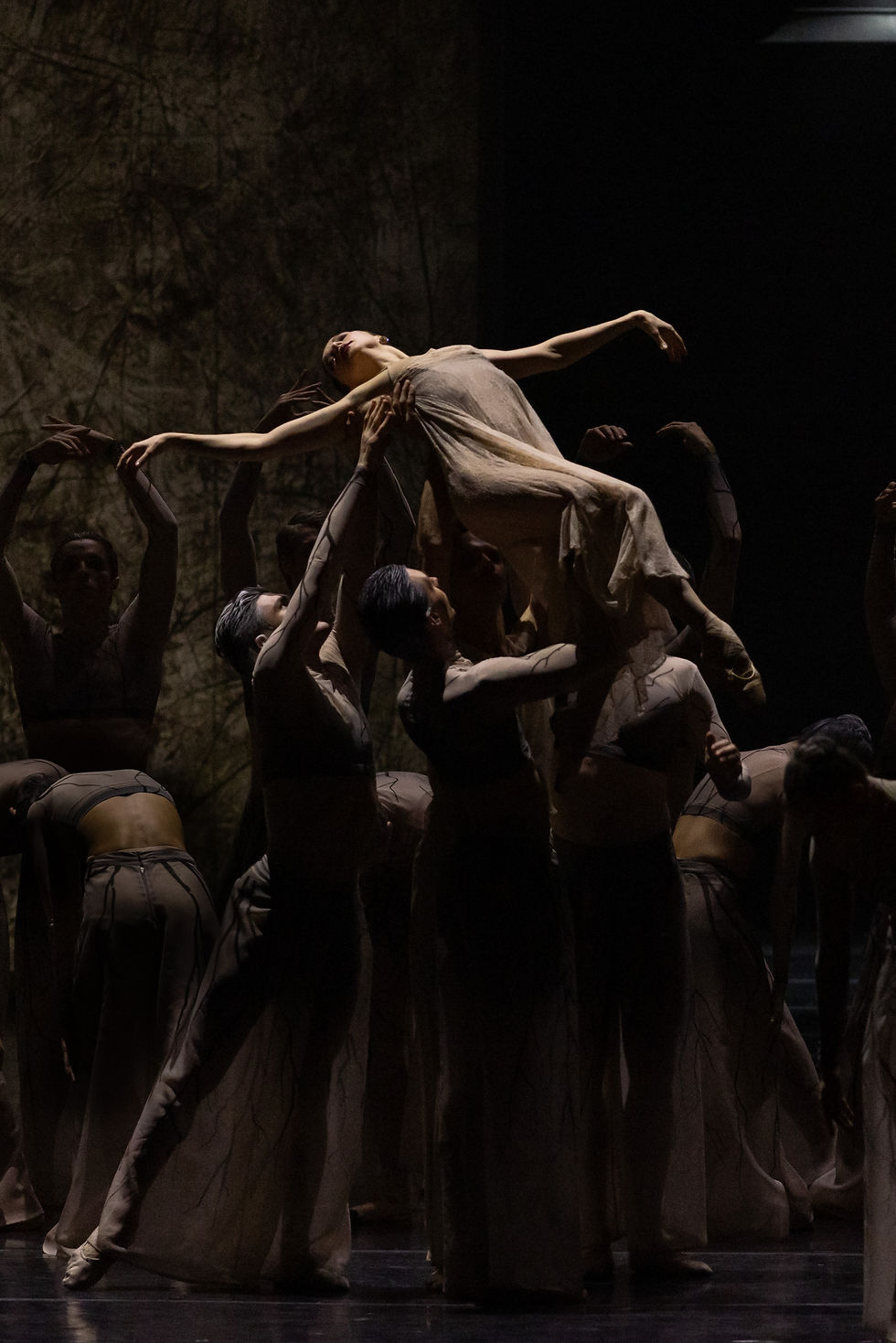
Here, the characters no longer appear in the familiar costumes they wore in the first act. All that remains of them is their soul, "dressed" in barely visible, translucent tunics outlined with branches.
The characters can be distinguished from one another only by their individual features, such as Varya’s distinctive braided bun.
The cherry trees are, in fact, the bodies themselves, flowing from one sculptural pose into another.
Both the physical movement and the musical content are the opposite of what was presented in The Cherry Orchard. The movements become more fluid, somewhat classical and less descriptive, while the waltz theme unites the entire Apollonian spectacle into an organic and pleasing picture.
Without keeping the literary source in mind, however, this image could be applied to almost any reflection on the nature of existence — a feature of the form of contemporary choreography.
The set consists of a single tall wall with a parchment-like texture, standing around almost the entire perimeter of the stage.

The dreamlike atmosphere unexpectedly shifts into a partial awakening of the characters. Dunyasha appears in her white apron, followed by the playful Charlotte, then Lopakhin — now without his waistcoat, but still wearing his familiar yellow shoes — and finally Ranevskaya in a wide-brimmed hat.
This procession of familiar characters is accompanied by a romantic waltz that gradually gathers momentum. Its melodic charm and carefree spirit are captivating and, strangely enough, bring the performance to a joyful conclusion.
The frantically anxious mood of the first part and the mythical, contemplative atmosphere of the second seem to coexist quite successfully in a balanced whole, offering a rare opportunity to experience two interpretations of a classic at once.
In this sense, the production has more than successfully achieved its principal aim: creating the effect of a dichotomy between the two acts. How productive each interpretation is, however, is a more ambiguous question. But if Chekhov’s cherries are all in bloom, in this performance they seem to be already withering.

Author: Maria Tyan
Photo: Karina Zhitkova, press department of the Stanislavsky Theatre
Comments