
Fearful Symmetries: Between Balanchine’s Radiance and Spuck’s Dim Light
Updated: Jun 19

The premiere of the ballet evening Fearful Symmetries took place in Berlin, bringing together one-act ballets by George Balanchine and Christian Spuck. The programme opened with one of Balanchine’s most celebrated works – Symphony in C, set to music by Georges Bizet.
Though I have never considered myself an unconditional admirer of Balanchine, this evening left behind a surprisingly joyful aftertaste – like a breath of fresh air in the repertoire of Staatsballett Berlin, where contemporary ballet forms have increasingly dominated in recent years.
What is remarkable about Symphony in C is the way its choreography makes the viewer hold their breath and follow, with almost narrative tension, not the development of a plot, but the unfolding of the dance itself. There are no sets, no dramatic intrigue, no external action in the usual sense. Yet from the very first scene, when the curtain opens and the dancers appear against a blue background in luminous classical costumes, an involuntary sigh of admiration seems to rise in the auditorium.
Perhaps this is precisely the special power of classical – and at the same time not entirely classical – ballet: the beauty of form becomes an event in itself. Line, symmetry, music, ensemble, purity of movement – everything works not as decoration, but as an independent form of dramaturgy.
In the first part of the ballet, Haruka Sassa especially shone alongside Kalle Wigle. The ballerina looked like a true prima: refined, composed, musical, with sculpted elongated lines, beautiful feet, soft arm movements and an elegant placement of the neck. Her dancing was not a demonstration of technique, but an expression of style, light and noble.

Alizée Sicre also deserves mention, bringing a distinctive French flair to Balanchine’s choreography. Her performance had grace, lightness and subtle musicality. Together with her partner Andrea Marino, she existed organically within this almost architectural Balanchine structure, where every gesture, every turn of the body and every entrance had to be absolutely precise.
The second movement made a less cohesive impression. In some episodes, the performance lacked the airiness and classical refinement that are especially important in Balanchine. In the dancing of Weronika Frodyma and Giovanni Princic, certain technical inaccuracies were noticeable at times: the movement seemed heavier, the lines not always sufficiently elongated, and the overall manner less free. In choreography built on purity of form, speed and almost jewel-like musicality, such nuances become immediately visible.
In the following sections, there were also dancers whose physical proportions did not always correspond ideally to the aesthetic of this ballet. At times the harmony of the silhouette was disrupted; at times the torso appeared too compact; elsewhere there was a lack of that elongation which allows Balanchine’s choreography to breathe. Against this background, Vera Segova stood out especially – with her long legs, enormous stride and natural scenic amplitude. Her appearance immediately added breadth and energy to the stage space.
And yet, despite certain rough edges, Symphony in C truly captured, impressed and delighted the audience.

Unfortunately, the second part of the evening was not as radiant – neither literally nor figuratively. Christian Spuck’s Fearful Symmetries immerses the viewer in a completely different visual atmosphere. The set design is executed in an antique copper-golden palette: somewhere between Baroque and an imaginary medieval state, where dark intrigues, struggles for influence and strange court rituals unfold.
Here, Weronika Frodyma appeared much more organic. Historical costumes, character roles and theatrical expressiveness suit her. In such parts – whether as Madame Bovary, the Red Queen in Alice in Wonderland, or here as a court lady waging her own small war with servants and followers – her artistic nature reveals itself far more convincingly.

However, the visual concept of the production often worked against the dancers. The stage space was immersed in semi-darkness, making it difficult at times to recognise even favourite artists – in this respect, the programme booklet genuinely helped. There was a sense that the individuality of the performers was deliberately dissolved into the overall choreographic construction.
The choreography of Fearful Symmetries itself certainly does not seem simple. On the contrary, it is intricate, intellectual, rhythmically charged and technically demanding. During the first ten minutes, one watches the dancers with great interest: the composition is fascinating, the movement pattern feels tense and multilayered, and the stage seems to live almost like an organism. Michelle Willems stood out in particular here, her precision and inner concentration giving the choreography additional expressiveness.
But gradually the action begins to lose its tension. What at first appears to be a complex and compelling structure becomes increasingly monotonous over time. The visual darkness, the repetition of movement motifs and the absence of a clear dramatic line create a sense of prolongation. The ballet remains intellectually constructed and professionally executed, but emotionally it involves the viewer less and less.
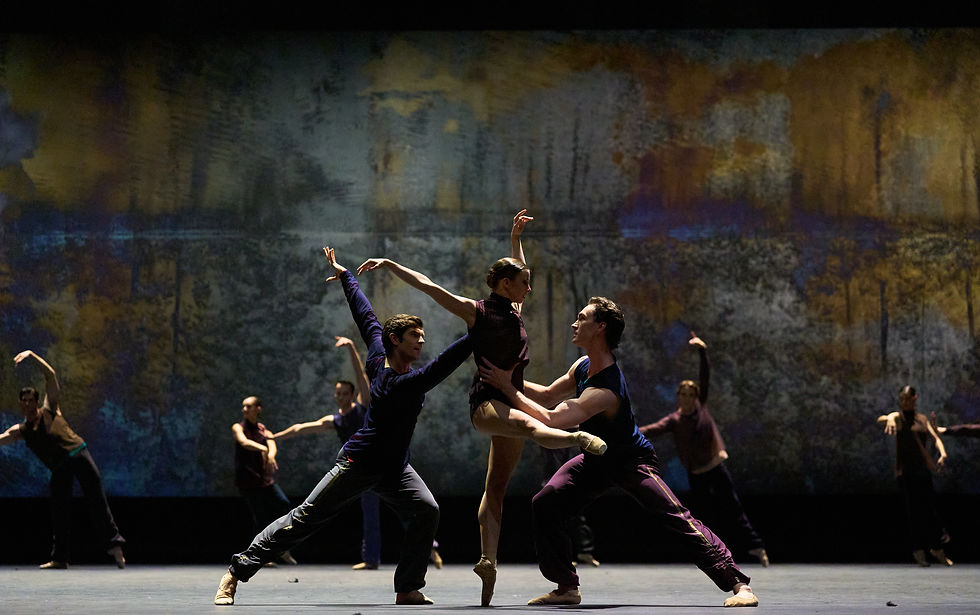
In this sense, Fearful Symmetries can be called a stylish and elegant ballet, created with evident taste and professional precision. Yet despite all its outward sophistication, it does not inspire genuine excitement.
After the bright, musical and almost festive Symphony in C, the second part of the evening feels especially heavy. The contrast is, of course, intentional: from Balanchine’s radiant symmetry to Spuck’s anxious, darker and more abstract symmetry. But while the first part leaves one wanting to return to it again, the second evokes respect for the concept rather than true theatrical pleasure.
Text: Julia Pneva
Photo: Carlos Quezada, Staatsballett Berlin
Comments