
Ivan Estegneev’s Demon’s Sorrow at Kirill Serebrennikov’s Festival in Berlin

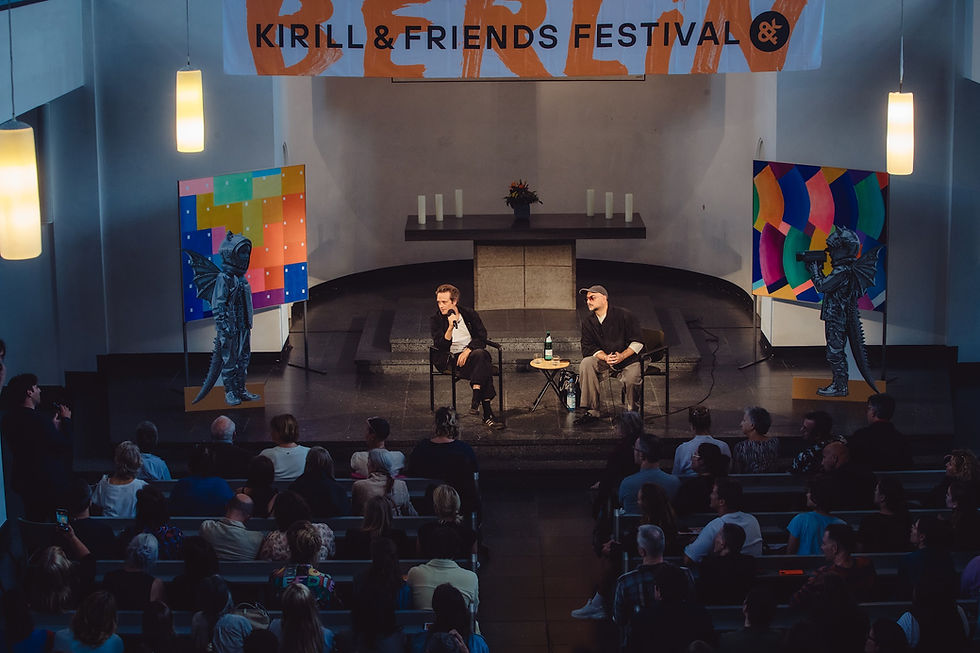
As the new theatre season began, Kirill Serebrennikov invited Berlin audiences to open a new chapter together in the company of friends. From 4 to 13 September, the inaugural Kirill & Friends Berlin Festival brought theatre, film screenings, exhibitions and artist talks to venues across the city. The invitation carried a wish to reunite people whom recent years have scattered across cities and countries. This made Ivan Estegneev’s Demon’s Sorrow, presented on the festival’s final day, all the more poignant: a story of a reunion that can no longer happen.
Theatregoers may know the choreographer’s name through his collaborations with Kirill Serebrennikov. Together with Evgeny Kulagin, he developed the movement language of Barocco, The Black Monk, Legende and Der Schneesturm. His career in contemporary dance has its own substantial history: he co-founded Dialogue Dance in Kostroma, the company’s productions have won three Golden Mask awards — Russia’s national theatre awards — and he served as curator of the Context. Diana Vishneva festival from 2022 to 2024.
Demon’s Sorrow (Die Trauer des Dämons) premiered in 2024 at Hamburger Sprechwerk in Hamburg. Created in exile, it was Estegneev’s first independent solo work in Germany. This pivotal piece draws on intensely personal experience: working with dramaturg Alexandr Andriyashkin, the choreographer tells a story of losing his father and finding the strength to go on living. Distance from home sharpens its pain. Grief is compounded by guilt over the years missed in a loved one’s life, over everything that can never be made up for.

Here, the choreographer’s private story meets the experience of many who left Russia after its full-scale invasion of Ukraine. As emigrants settle into new countries and build new lives, their parents grow older back home. Between video calls lies everything a screen cannot convey: everyday closeness, the simple possibility of spending time together. With every visit postponed, the fear grows that there may not be another.
The theme has a painful echo in the life of the festival’s founder. Kirill Serebrennikov’s mother died in 2018, while he was under house arrest. He was allowed to attend her funeral. His father died in September 2024, when the director was already living in exile. "He didn’t ask me to come; he understood that it was impossible," Serebrennikov wrote in farewell.

Against this background, the question to which the protagonist keeps returning cuts especially deep: "I am a piece of art?" or "I am a piece of shit?". Beneath the blunt language lies an argument with oneself in which no defence ever seems sufficient. Leaving to preserve your freedom, continue working and make art is an understandable choice. But how do you reconcile it with the fact that your parents remained far away, and that their final years passed without you? Guilt is unmoved by reason. It demands your presence where you cannot be.
Onstage, this feeling acquires weight. A small stone presses against the dancer’s chest, while a larger boulder supports his body. Stone allows for opposing readings: it can hold a person up or weigh them down. This double meaning evokes both the father as the foundation on which a person’s life is built and the weight of a debt to a loved one who can no longer hear us.

Gradually, the stone’s stillness seems to pass into the protagonist’s body. In one of the most affecting scenes, the naked dancer sinks into a black expanse resembling a lake of grief. Guilt, fear, despair and the pain of loss paralyse his body and engulf him entirely. He disappears beneath its surface, becoming one with the darkness. When he rises again, recalling Botticelli’s Venus, he freezes like a statue. Grief and darkness seem to have driven out everything that once allowed him to feel, desire and move forward.
Then a disembodied voice intervenes. It rejects this ending and insists on rebirth. It might be a demon or an alter ego, or the voice of fear and pain with which the protagonist is locked in endless conversation. Its demand feels almost cruel: how can someone be ordered to leave their pain behind and return to life? Yet the performance, like life, goes on. After the paralysis, there has to be at least one action: getting up, getting dressed, taking the next step.

One detail in this everyday sequence stands out: the protagonist retrieves his shirt from beneath the armour lying onstage. The empty armour suggests a lingering paternal presence: the strength and protection that once offered shelter, and the responsibility for loved ones that the protagonist must now assume. The scene evokes a kind of growing up for which no one can fully prepare. Whatever our age, while our parents are alive, we remain children.
Taking on this responsibility does not mean being ready to say goodbye. In one scene, the protagonist reaches for a white hand and begs it not to let him go. His plea holds the desperation of someone who needs just a little more time with a loved one: to prolong a touch, to delay the farewell. In the final scene, a tiny white hand appears at the breast pocket of his black jacket. It seems to answer that earlier plea. The bond with the person he has lost endures, though it must now take another form. He carries with him the memory of a closeness that death has not erased. The idea that our parents live on in us takes visible form.

The work’s candour extends far beyond its onstage nudity. Ivan Estegneev shares feelings that can be difficult to admit even to those closest to us: helplessness, shame, the need for protection, the wish to hold a father’s hand once more. The piece can be read as a struggle with personal demons, but it speaks most convincingly about grief gradually taking possession of a person.
Demon’s Sorrow itself seems to embody the protagonist’s return to life after becoming as still as stone. Here, one senses the therapeutic power of art. Loss is irreversible and beyond our control, yet we can choose what to do with the darkness that overtakes us.

May the artists and audiences of Kirill & Friends Berlin Festival come together again next year for a second edition. And may Ivan Estegneev and all of us find room once more for happiness and love, alongside the memory of those we have lost. May those memories one day bring more warmth than pain.
Text: Margarita Makhrina
Photo: press department of the festival
Comments